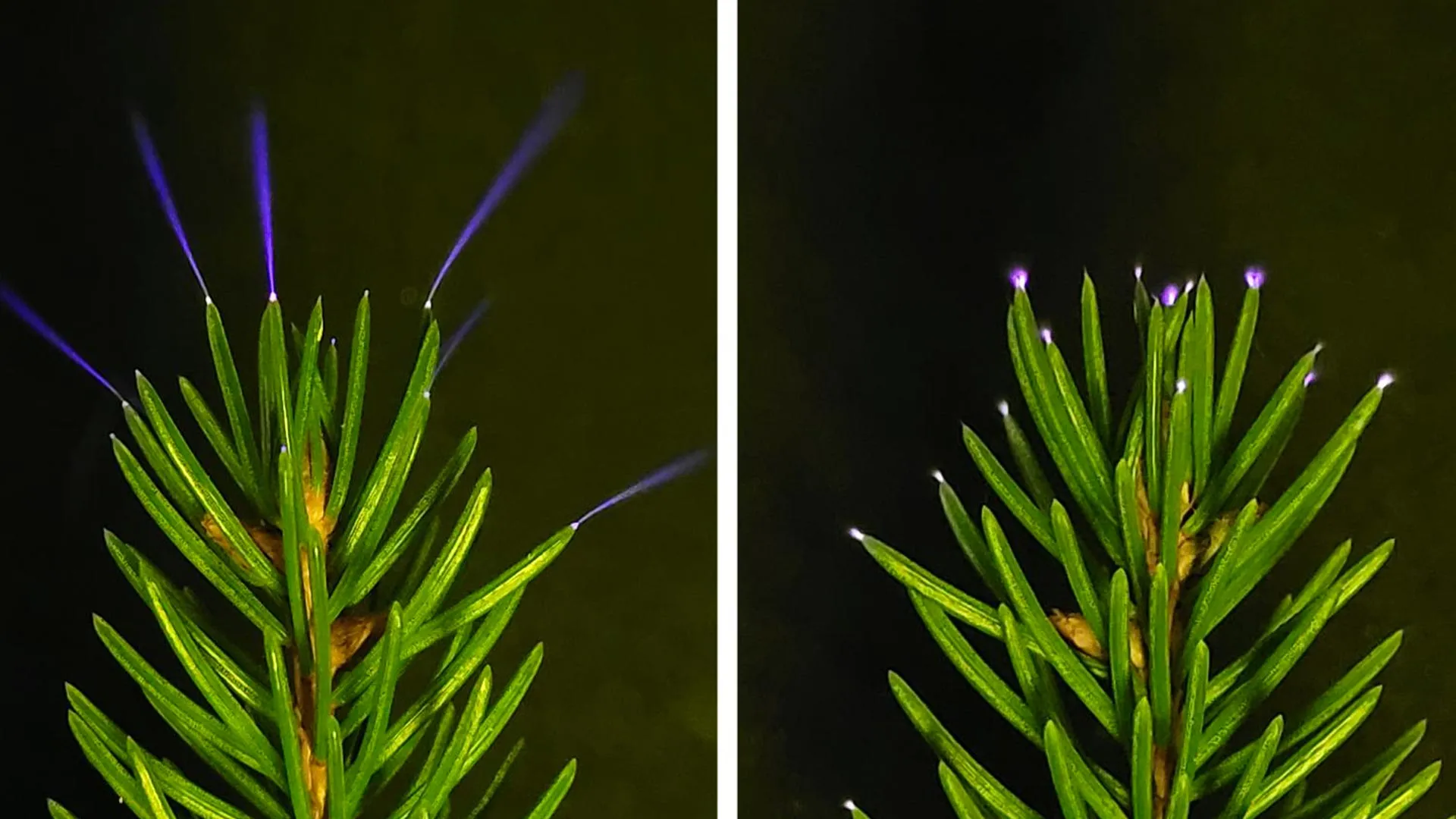
For decades, the idea that trees might glow during a thunderstorm remained a theoretical curiosity, confined to laboratory simulations and the margins of atmospheric physics. Recently, however, researchers operating from a retrofitted minivan managed to document the phenomenon in the wild. These “corona discharges”—faint, ultraviolet shimmers emanating from the sharp tips of leaves—represent a subtle but significant interaction between the earth and the sky.
The discovery confirms that under the intense electric fields of a passing storm, the points of a forest canopy act as natural conductors. These tiny bursts of electricity are not merely a visual spectacle; they trigger a cascade of chemical reactions. By ionizing the air immediately surrounding the foliage, these discharges produce hydroxyl radicals and other highly reactive molecules.
This process suggests that forests may serve as massive, decentralized air purifiers during volatile weather. These reactive molecules are capable of breaking down greenhouse gases and pollutants, effectively scrubbing the atmosphere. The finding reframes the forest not just as a carbon sink or a passive ecosystem, but as an active, electrical participant in the planet’s chemical regulation.
With reporting from Science Daily.
Source · Science Daily