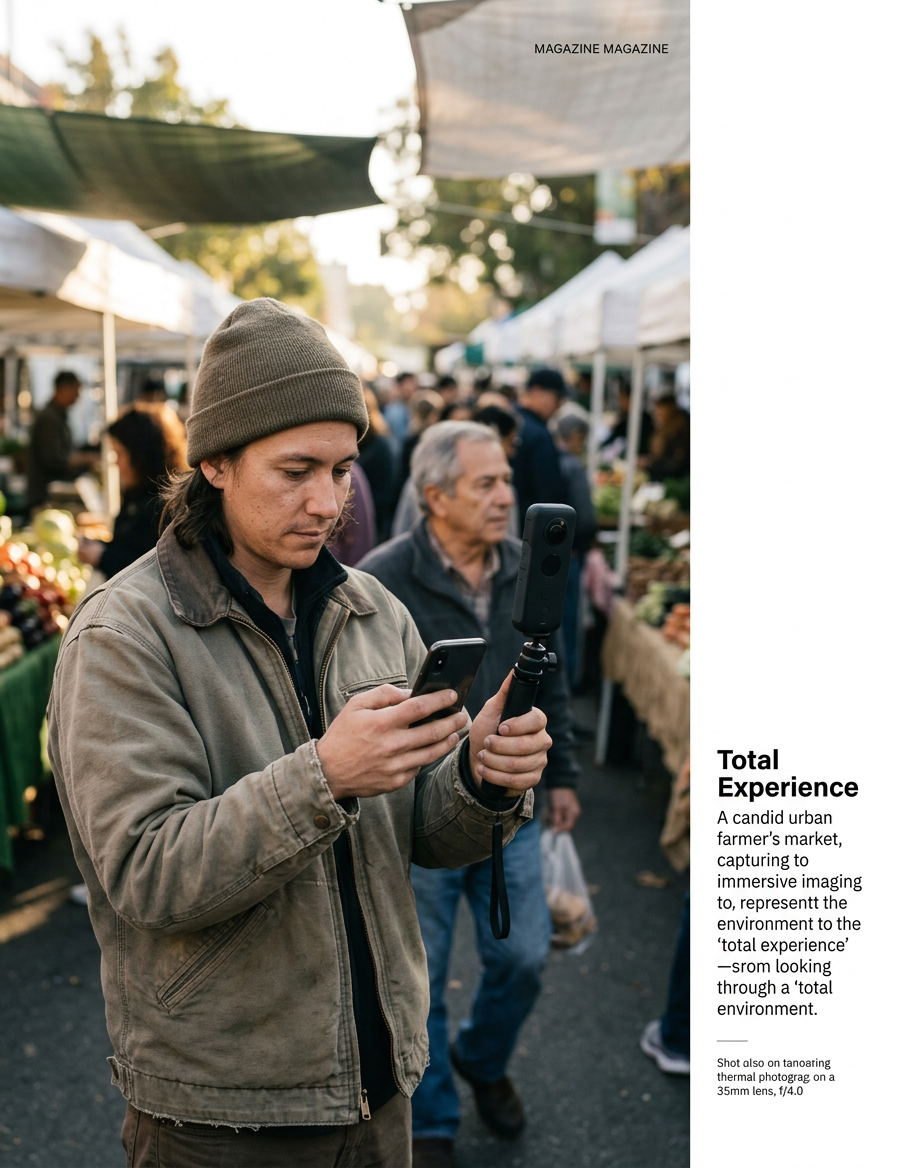
The history of photography is largely a history of exclusion. To frame a shot is to decide what is worth looking at and what should be left in the periphery. Whether it is a mountain sunset or a bustling city street, the traditional lens forces a choice, inevitably losing the environmental context that makes a moment feel complete. The emergence of 360-degree cameras — devices that stitch together feeds from multiple wide-angle lenses to produce a seamless spherical image — represents a fundamental shift in that logic. Rather than capturing a selective slice, these cameras record the entire visual environment at once, handing the act of framing to the viewer after the fact.
The technology is not new in principle. Panoramic photography dates back to the mid-nineteenth century, when photographers used rotating cameras or assembled multiple exposures to approximate a wider field of view. What has changed is the compression of that process into a single, handheld device capable of recording high-resolution spherical video in real time. The result is a medium that no longer asks "what should the viewer see?" but instead offers "here is everything — look where you choose."
From Niche Tool to Broader Medium
For most of the past decade, 360-degree cameras occupied a narrow commercial lane. Action sports enthusiasts mounted them on helmets and handlebars; real estate agents used them to produce virtual property tours; a handful of documentary filmmakers experimented with immersive storytelling. The devices were expensive, the files unwieldy, and the viewing experience depended on specialized headsets or clumsy drag-and-scroll interfaces on flat screens.
Several converging developments have begun to widen that lane. Sensor miniaturization has improved image quality while shrinking form factors. Software-based stabilization and automated stitching have reduced the post-production burden that once made 360-degree content impractical for casual users. And the gradual spread of mixed-reality headsets — even if mass adoption remains uncertain — has created a more natural viewing surface for spherical media. Together, these shifts have lowered the barrier enough that immersive capture is moving from a specialist technique toward something closer to a consumer format.
The implications extend beyond convenience. When every direction is recorded simultaneously, the relationship between photographer and subject changes. The person behind the camera can no longer hide behind it; they become part of the scene. Composition, the foundational discipline of visual art, does not disappear, but it migrates downstream — from the moment of capture to the moment of consumption. The creative authority that once belonged exclusively to the image-maker is now shared with the audience.
What Is Gained and What Is Lost
Traditional photography derives much of its power from constraint. A well-composed frame directs attention, establishes hierarchy, and communicates intent. The photographer's eye is, in a meaningful sense, the art itself. By removing the frame, 360-degree imaging gains environmental fidelity but risks sacrificing narrative control. A spherical capture of a protest march records every angle, yet it may fail to convey the tension that a single, tightly cropped photograph of a face in the crowd can deliver.
This tension mirrors earlier debates in media history. The transition from edited cinema to live television raised similar questions about the trade-off between completeness and curation. Each new medium that promises "more" forces a renegotiation of what "enough" means — and whether totality enhances understanding or merely overwhelms it.
For documentation and archival purposes, the value proposition is clearer. Urban planners, conservationists, and cultural heritage organizations have an obvious interest in recording environments with maximum spatial information. In those contexts, the goal is not storytelling but preservation, and the frame is an obstacle rather than a tool.
The deeper question is whether immersive capture will develop its own grammar — a set of conventions that guide attention within a frameless space — or whether it will remain a powerful recording technology in search of an artistic language. Photography took decades to establish itself as more than mechanical reproduction. The 360-degree image sits at a similar crossroads: technically capable of capturing everything, still working out what it wants to say.
With reporting from El País Tecnología.
Source · El País Tecnología