For the one in four Americans living with a disability, the most effective assistive technology often lacks a circuit board. Canine Companions, a California-based nonprofit, has spent decades refining the art of pairing service dogs with individuals who need them — from wheelchair users requiring help with physical barriers to veterans navigating the invisible architecture of post-traumatic stress. Brenda Schafer Kennedy, the organization's chief veterinary and research officer, views these partnerships through the dual lenses of biological precision and technological innovation. Her work sits at an unusual intersection: veterinary medicine, behavioral science, and wearable hardware.
The efficacy of a service dog begins long before training. Kennedy oversees a rigorous breeding program designed to minimize medical risks, ensuring that the animals placed — more than 7,000 to date — possess the health and longevity necessary for their demanding roles. The goal is to prevent the emotional and logistical burden of a service animal facing its own premature health crisis, a priority that requires a sophisticated understanding of canine genetics and preventive care. A service dog that develops hip dysplasia or cardiac disease mid-career does not merely lose its working capacity; it disrupts the daily autonomy of the person who depends on it.
From breeding programs to biometric collars
Service dog organizations have historically relied on behavioral selection and structured training regimens to produce reliable working animals. The science of the field has advanced considerably over the past two decades, with breeding programs incorporating genetic screening protocols that were once confined to academic research. The underlying logic is straightforward: a dog bred for temperament stability, joint health, and cardiovascular resilience is more likely to complete a full working life — typically eight to ten years — without costly medical interruptions.
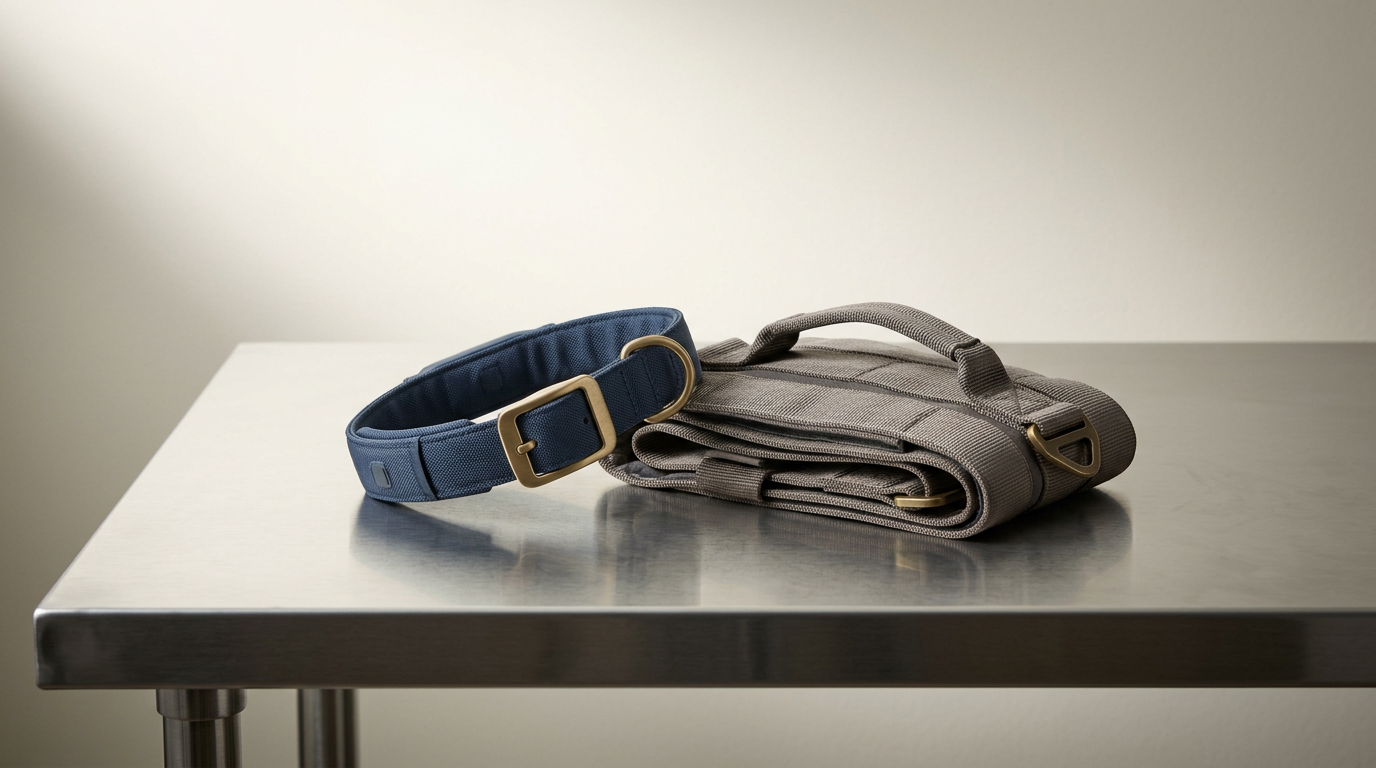
What distinguishes the current phase of Kennedy's work is the addition of a digital layer. She is a co-inventor of CanineAlert, a patented wearable device that monitors a user's heart rate. When the system detects the physiological spikes associated with nightmares — a common symptom of post-traumatic stress disorder — it sends a signal to the dog's collar, prompting the animal to wake its owner. The concept transforms the service dog from a passively trained responder into a node in a closed-loop biometric system. Rather than relying solely on the dog's ability to detect distress cues through scent or sound, the device provides an explicit physiological trigger.
This matters because the traditional model of psychiatric service dogs depends on the animal's capacity to read subtle human signals — changes in breathing, body odor, or movement patterns. That capacity is real but inconsistent, varying with the dog's alertness, proximity, and individual sensitivity. A wearable bridge between human physiology and canine response narrows the margin of error.
The harder question: where does the dog end and the device begin?
Plans to expand CanineAlert to address daytime anxiety episodes suggest a broader ambition: a platform in which biometric monitoring continuously mediates the relationship between handler and animal. The trajectory raises questions that extend well beyond veterinary science.
One concerns regulatory classification. Wearable medical devices in the United States fall under the purview of the Food and Drug Administration, while service animals are governed by the Americans with Disabilities Act. A hybrid system that depends on both a living animal and a sensor-driven alert mechanism does not fit neatly into either framework. How such a product would be evaluated for safety and efficacy — and by whom — remains an open question.
Another concerns the nature of the human-animal bond itself. Service dog practitioners have long emphasized that the relationship between handler and dog is therapeutic in its own right, independent of any specific task the animal performs. If a wearable device assumes a growing share of the detection and response functions, the role of the dog shifts. Whether that shift enhances the partnership or subtly diminishes it is not a question technology alone can answer.
The tension is productive rather than paralyzing. Biometric wearables offer precision that animal intuition cannot guarantee; animal companionship offers psychological benefits that no sensor can replicate. Kennedy's work forces both communities — technologists and animal behaviorists — to define what each side of that equation is actually providing. The answer will shape not only the future of service dog programs but the broader design philosophy of assistive technology: whether the goal is to replace biological intelligence with digital systems, or to make the two work in concert.
With reporting from MIT Technology Review.
Source · MIT Technology Review