The concept of the "smart home" once implied expensive, hard-wired systems integrated during a building's construction — a luxury reserved for new builds with dedicated budgets for automation. Today, that friction has largely vanished, replaced by modular devices that bridge the gap between legacy appliances and the internet. Among them, the smart plug has emerged as the primary instrument of this transition, offering a low-cost, non-invasive method to bring analog hardware into the digital fold.
Recent offerings in the market, such as the Positivo Smart Plug and TP-Link's Tapo P110, demonstrate how these devices have matured beyond simple remote switches. While voice assistant integration with Alexa and Google Home remains a standard feature, the focus is shifting toward granular energy telemetry. TP-Link's P110, for instance, provides real-time monitoring of power consumption, transforming a simple outlet into a diagnostic tool for household efficiency. For higher-demand appliances like air conditioners or heaters, more robust options like the Positivo Smart Plug Max (16A) are becoming available, designed to handle the electrical loads that standard smart plugs cannot safely manage.
From Remote Switch to Energy Dashboard
The evolution of the smart plug mirrors a broader pattern in consumer technology: devices that begin as single-function novelties gradually absorb adjacent capabilities until they occupy a different category entirely. Early smart plugs did little more than allow a user to toggle a lamp from a phone. The current generation layers on scheduling, energy consumption tracking, and integration with automation routines — turning a passive outlet into an active node in a home's energy infrastructure.
This shift matters because residential energy management has historically been opaque. Utility bills arrive as aggregate numbers, offering no visibility into which devices consume the most power or when peak usage occurs. A smart plug with energy telemetry changes that equation at the individual appliance level. When multiplied across a household, the data becomes a practical tool for identifying waste and adjusting behavior. The value proposition, in other words, has moved from convenience to cost management — a far more durable reason for adoption.
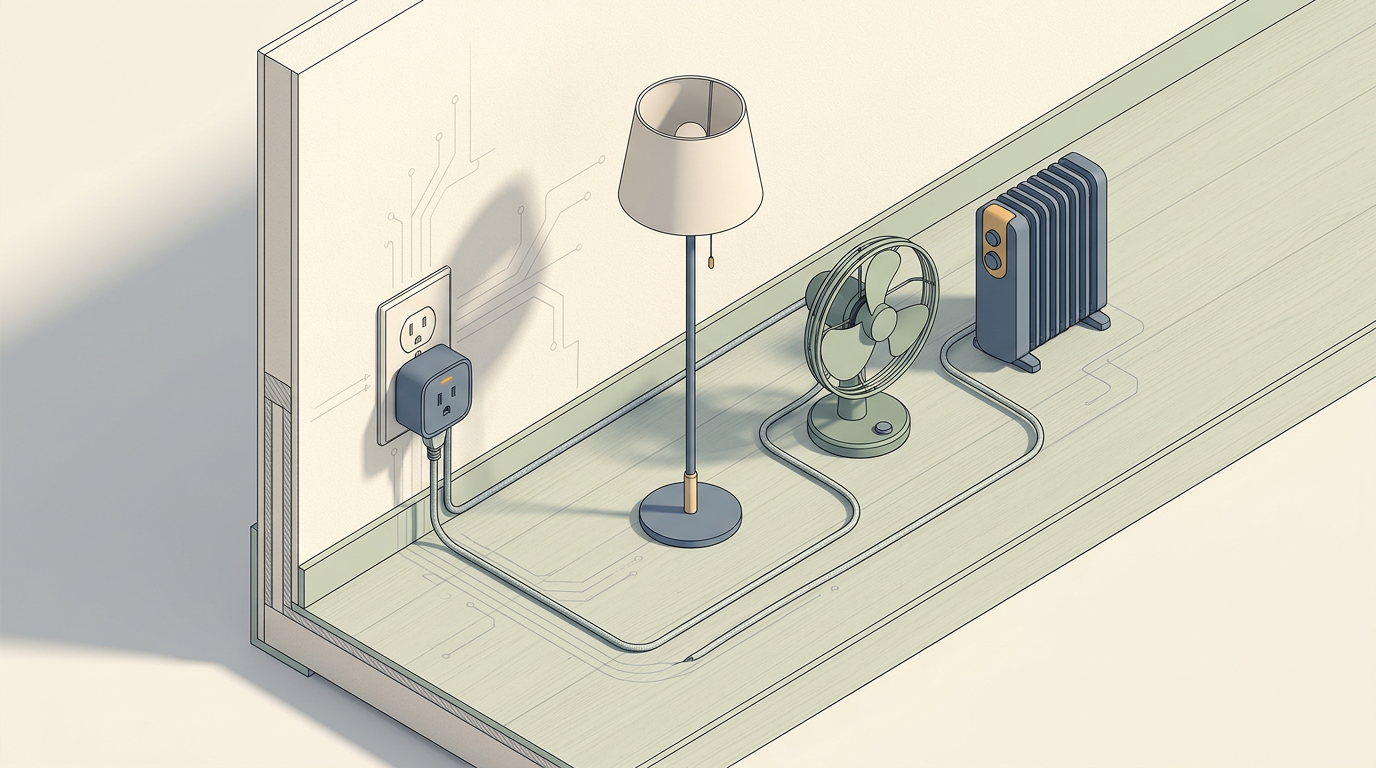
The interoperability layer reinforces this trajectory. By integrating with ecosystems like Tuya, Samsung SmartThings, or Apple HomeKit, smart plugs participate in conditional automation routines: a fan that activates when a temperature sensor crosses a threshold, or a charger that disconnects once a battery reaches capacity. These are not futuristic scenarios but configurations available today through consumer-grade hardware. The plug becomes less a product and more a protocol adapter — a translator between the analog world of existing appliances and the logic layer of a connected home.
The Infrastructure Play Hiding in Plain Sight
There is a strategic dimension worth noting. Smart plugs sit at the intersection of two large and converging markets: home automation and distributed energy management. As utility grids in several countries experiment with time-of-use pricing and demand-response programs, the ability to programmatically control when appliances draw power becomes economically meaningful, not just for individual households but for grid stability at scale.
This positions the humble smart plug as potential infrastructure — a low-cost endpoint that could, in aggregate, participate in demand-side management if the software and regulatory frameworks catch up. The hardware is already deployed in millions of homes. The question is whether platform operators and energy providers will build the coordination layers to unlock that latent capacity.
For now, the immediate story is simpler and no less significant. Smart plugs represent the lowest-friction entry point into home automation: no electrician, no rewiring, no commitment to a single ecosystem. They convert any outlet into a programmable interface. As the devices grow more capable and the ecosystems around them more mature, the gap between a house with a few smart plugs and a purpose-built smart home continues to narrow. Whether that convergence ultimately serves the consumer, the platform, or the grid operator most — or whether those interests can be aligned — remains the open question at the center of the connected home's next chapter.
With reporting from Olhar Digital.
Source · Olhar Digital