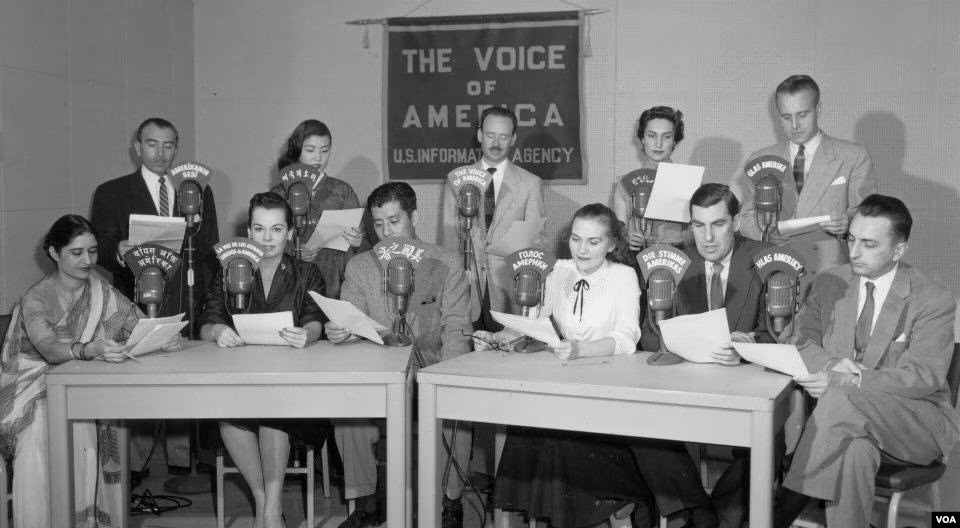
The transition at Voice of America in early 2025 was expected to be a pivot, but it arrived instead as a rupture. For decades, the broadcaster has functioned as the primary vector for American soft power — a concept, formalized by political scientist Joseph Nye in the late 1980s, predicated on the idea that national influence is best projected through the steady, credible dissemination of democratic values and objective reporting. When that institutional bedrock begins to shift, the implications extend far beyond a mere change in management; they signal a transformation in how a superpower communicates with the world.
Voice of America was established in 1942, during the Second World War, as a vehicle for broadcasting American perspectives into territories under Axis control. Over the following eight decades, it grew into a global media operation reaching audiences in more than forty languages. Its charter, codified by Congress in 1976, enshrined three principles: accuracy and objectivity in reporting, representation of the full spectrum of American thought, and a clear presentation of U.S. government policy. The tension between that final mandate and the first two has defined the institution's internal politics ever since.
The Firewall and Its Erosion
Soft power is a delicate instrument, reliant on a perceived distance between the state's political apparatus and its cultural output. At Voice of America, this distance has historically been maintained by a statutory "firewall" — a set of legal and editorial protections designed to insulate journalistic decisions from executive interference. The firewall's logic is straightforward: a broadcast perceived as propaganda loses the credibility that makes it useful in the first place. Audiences in authoritarian states, the primary targets of U.S. international broadcasting, are acutely sensitive to the difference between independent journalism and state messaging. They already live with the latter.
The challenge is that the firewall has always been more norm than fortress. Its strength depends on the willingness of successive administrations to respect it. Previous moments of strain — during the Nixon era, during early clashes in the George W. Bush administration over coverage of the war on terror — tested the boundary but did not collapse it. The events described in early 2025 suggest a qualitatively different kind of pressure, one in which the boundary between state messaging and partisan rhetoric is not merely tested but treated as an obstacle to be removed. The chaos reported by those within the organization reflects a deeper anxiety: that the signal is being swallowed by the noise of domestic upheaval.
This pattern is not unique to the United States. The BBC World Service, long considered the gold standard of state-funded but editorially independent broadcasting, has faced its own recurring battles over funding and autonomy with the British government. France's international media apparatus has undergone similar cycles of political interference and editorial pushback. What distinguishes the American case is the scale of the infrastructure at stake and the degree to which U.S. soft power has historically depended on the perception — however imperfect — that its cultural exports operate at arm's length from the White House.
Credibility as Strategic Capital
The crisis at Voice of America serves as a case study in institutional fragility. When the mechanisms of public diplomacy are repurposed for immediate political ends, the long-term capital of credibility is often the first casualty. Credibility, in the context of international broadcasting, functions much like a reserve currency: it accumulates slowly, through consistent behavior over time, and can be depleted far more rapidly than it was built. Audiences who lose trust in a source do not simply return when editorial independence is restored; they migrate to alternatives, some of which may be adversarial.
The competitive landscape has shifted as well. China's CGTN, Russia's RT, and a constellation of regional state-backed outlets have expanded their reach precisely by filling informational gaps in markets where traditional Western broadcasters have retreated or lost credibility. The contest for global attention is no longer a unipolar affair, and the cost of vacating the field — even temporarily — compounds over time.
In an era where the competition for that attention is increasingly fractious, the loss of a clear, independent voice may leave a vacuum that no amount of hard power can truly fill. Whether the institutional norms that once protected American soft power can be reconstituted, or whether the rupture marks a permanent shift in the relationship between the state and its outward-facing media, depends on forces that remain in open tension: the political incentives of the moment against the strategic patience that credibility demands.
With reporting from The Point Magazine.
Source · The Point Magazine