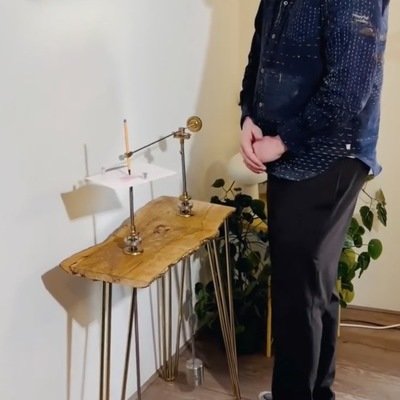
The harmonograph — a mechanical drawing apparatus that uses the oscillation of pendulums to trace geometric patterns on paper — dates to the mid-nineteenth century, when it became a fixture of Victorian parlors and scientific salons. The device was equal parts entertainment and education, a way to visualize the mathematics of wave interference through physical means. Over the decades, it largely faded into the category of scientific curiosity, occasionally revived by hobbyists and educators. Netherlands-based artist Ralf Jacobs has taken the concept considerably further, engineering a version of the machine that functions as both kinetic furniture and high-precision drawing instrument.
Jacobs, who operates at the intersection of signal processing and industrial design, has built a harmonograph whose central innovation is a custom-designed hinge mechanism engineered to be virtually frictionless. That technical detail matters more than it might initially appear. In a conventional harmonograph, mechanical friction at the pivot points steadily degrades the pendulum's motion, shortening the drawing time and blurring the finer details of the geometric output. By minimizing that resistance, Jacobs extends the period over which the instrument can trace the slow decay of momentum — and in doing so, captures a far richer record of the physics at work.
Signal Without Noise
Jacobs frames his practice through the language of signal processing, a discipline concerned with extracting meaningful information from complex or noisy data. In his formulation, the physical forces acting on the pendulums — gravity, initial impulse, air resistance — constitute the signal. Mechanical friction at the joints constitutes noise. The frictionless hinge, then, is not merely a technical improvement; it is an act of editorial precision, stripping away the artifacts that would otherwise distort the output.
The resulting drawings are dense, layered geometric forms — Lissajous-like curves that record the interaction of multiple oscillating axes over time. Lissajous figures, named after the nineteenth-century French physicist Jules Antoine Lissajous, are the patterns produced when two sinusoidal motions are combined at right angles. They have long been used in physics and engineering to visualize frequency relationships. Jacobs' harmonograph produces a physical, analog version of these figures, but with the added complexity of real-world variables: the slight asymmetry of a hand-applied push, the gradual surrender of energy to air and gravity.
Each drawing, in this sense, is less an aesthetic composition than a data log — a tangible record of a specific moment of interaction between a human operator and a set of physical laws. No two outputs are identical, because no two initial conditions are identical.
Furniture as Instrument
The decision to frame the harmonograph as furniture rather than as a standalone art tool is worth examining. It places the object in the domestic environment, where it must justify its presence not only through function but through form. The machine becomes a permanent resident of a living space, not a temporary installation in a gallery. This shifts the relationship between viewer and object: the harmonograph is not something to be observed from behind a rope line but something to be used, repeatedly, by its owner.
There is a broader design lineage here. The tradition of embedding scientific or mechanical function into domestic objects — orreries on mantelpieces, barometers in hallways, astrolabes as decorative instruments — has deep roots in European craft culture. Jacobs' harmonograph sits within that tradition, though updated with contemporary engineering tolerances and a conceptual framework drawn from information theory rather than natural philosophy.
What remains open is whether the frictionless harmonograph points toward a wider category of objects — instruments that occupy domestic space while producing artifacts of genuine scientific or aesthetic value. The tension between furniture and laboratory equipment, between decoration and data, is precisely where Jacobs' work operates. Whether that tension resolves into a broader design movement or remains the province of a single practitioner's vision is a question the work itself does not answer.
With reporting from Core77.
Source · Core77