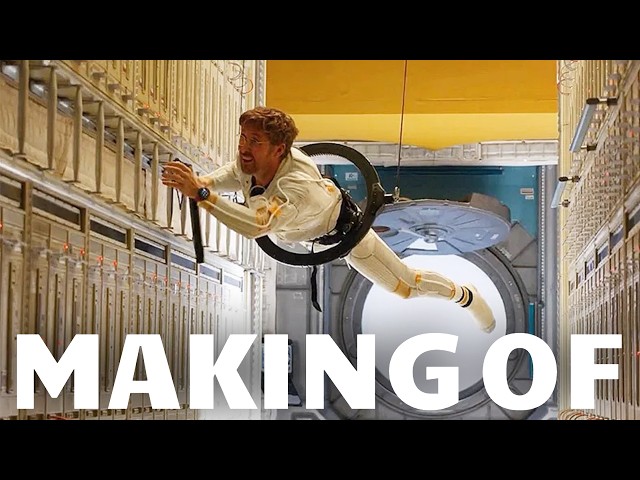
The adaptation of Andy Weir’s Project Hail Mary represents a specific challenge in contemporary production design: the necessity of building a spacecraft that functions as a plausible laboratory rather than a cinematic stage. When production designer Charlie Wood constructed the interior of the titular ship, the mandate was not mere aesthetic immersion, but functional coherence. Unlike the sprawling, gravity-defying environments of standard space operas, the Hail Mary operates under strict physical constraints dictated by the novel’s hard sci-fi premise. The resulting set is a densely packed, dynamic environment where every console, airlock, and centrifuge serves a narrative purpose. Designing for this level of technical scrutiny forces filmmakers to abandon the frictionless perfection of digital extensions in favor of tangible, claustrophobic reality.
The Engineering of Immersion
Wood’s approach to the Hail Mary echoes the foundational work of Harry Lange and Frederick Ordway on Stanley Kubrick’s 2001: A Space Odyssey. In both cases, the production team prioritized engineering logic over traditional set decoration, consulting with aerospace experts to validate their designs. The Hail Mary’s interior must account for shifting gravitational states—from zero-g to thrust-induced gravity—which fundamentally alters how the crew interacts with their environment. This requires a set that is physically dynamic, capable of rotating or reorienting to reflect the ship's current physical state during long-haul interstellar transit.
The reliance on fully immersive, 360-degree practical sets marks a deliberate departure from the current industry standard of relying heavily on LED volumes or green screens like those popularized by The Mandalorian. By enclosing the actors in a complete physical structure, the production enforces a natural, undeniable claustrophobia. The spatial limitations of the Hail Mary are not merely background details; they are active antagonists in the narrative. Every instrument panel, storage bay, and tether point must look as though it belongs to a heavily funded aerospace agency rather than a Hollywood prop department, demanding a level of material authenticity that digital fabrication still struggles to fully replicate.
Translating Weir's Technical Prose
Andy Weir’s literary signature is his obsessive attention to scientific minutiae. Just as The Martian relied on orbital mechanics and botany to drive its plot, Project Hail Mary hinges on stellar physics, advanced materials science, and xenobiology. Translating this hyper-technical prose into visual media requires the production design to carry a significant portion of the narrative exposition. The scientific equipment aboard the ship cannot just look vaguely futuristic; it must visually communicate its specific function to the audience without requiring tedious dialogue or breaking the pacing of the film.
This design philosophy extends beyond the ship's primary architecture to the spacesuits and modular tools used by the crew. When Adam Savage examined the film's spacesuit, the focus was entirely on practical metrics: joint mobility, life support integration, and tactile feedback—the same rigorous standards used by modern agencies like NASA or SpaceX. The aesthetic of the Hail Mary is inherently utilitarian, stripping away cinematic gloss. There are no sleek, cavernous corridors or ambient mood lighting; instead, the visual language is defined by exposed wiring, heavy-duty mechanical latches, and the harsh, clinical glare of emergency lighting. This commitment to industrial realism grounds the speculative, deeply alien elements of the story in a recognizable, tactile universe.
The physical construction of the Hail Mary set underscores a broader tension in modern filmmaking: the friction between digital convenience and practical authenticity. As audiences become increasingly sensitized to the weightless quality of CGI environments, a return to rigorous, physically constructed spaces offers a necessary anchor. The success of the film, releasing March 20th, will largely depend on whether Wood’s intricate sets can silently convince the viewer that this ship could actually fly. The frontier of sci-fi cinema may not lie in better rendering software, but in better carpentry.
Source · The Frontier | Movies