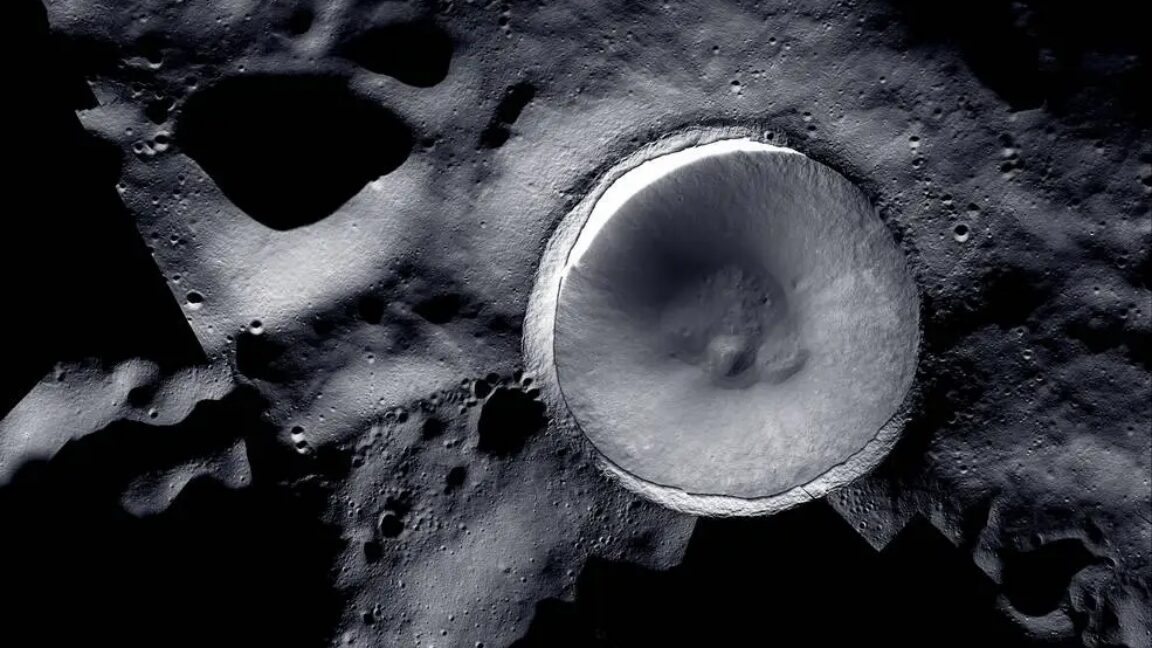
The lunar south pole is no longer a distant scientific curiosity; it has become the most contested real estate in the solar system. Later this year, two of the most sophisticated robotic missions ever conceived will attempt to land near the rim of Shackleton Crater, a permanently shadowed depression at the Moon's south pole where temperatures plunge below minus 170 degrees Celsius. At those extremes, water ice deposited by comets and solar wind over billions of years remains trapped in darkness, never exposed to sunlight that would cause it to sublimate into space. The strategic logic is straightforward: water can be split into hydrogen and oxygen, yielding both breathable air and rocket propellant. Whoever demonstrates the ability to locate, extract, and use that ice gains a foundational advantage in the economics of deep-space operations.
Jeff Bezos' Blue Origin is fielding the Endurance spacecraft, a lander so massive it dwarfs the Apollo lunar modules that carried astronauts half a century ago. Recently transferred from NASA's Johnson Space Center to Cape Canaveral, Endurance is undergoing final preparations for its debut atop the New Glenn heavy-lift rocket. Simultaneously, China's Chang'e 7 mission has arrived at the Wenchang Space Launch Site on Hainan Island. The arrival of both missions at their respective launch pads signals a shift from theoretical planning to the kinetic reality of a new lunar contest.
Two architectures, one objective
The American and Chinese approaches to Shackleton reflect distinct engineering philosophies shaped by different institutional constraints. Endurance is built around sheer payload capacity. Blue Origin's strategy bets that landing a large, capable platform near the crater rim — one designed to serve as infrastructure for future crewed missions under NASA's Artemis program — is more valuable than a narrowly scoped science sortie. The mission represents a pivotal moment for Blue Origin, transitioning the company from suborbital tourism aboard New Shepard to the front rank of deep-space logistics. Success would validate both the New Glenn launch vehicle and Blue Origin's credibility as a prime contractor for sustained lunar operations.
China's Chang'e 7, while built around a smaller lander, compensates with architectural complexity. The mission comprises an orbiter, a rover, and a specialized "hopper" drone designed to leap into the crater's lightless depths and sample ice directly. This layered approach distributes risk across multiple vehicles and maximizes the scientific return from a single launch window. It also extends a track record that already includes the far-side landing of Chang'e 4 in 2019 and the sample-return success of Chang'e 5 in 2020 — missions that demonstrated China's ability to execute increasingly difficult lunar operations on schedule.
The resource question beneath the prestige race
The competition at Shackleton sits at the intersection of science, commerce, and geopolitics. The Outer Space Treaty of 1967 prohibits national sovereignty claims over celestial bodies, but it says little about the extraction and use of resources found there. The United States addressed part of that ambiguity through the Artemis Accords, a set of bilateral agreements establishing norms for lunar resource utilization, transparency, and deconfliction of operations. China is not a signatory. The absence of a shared legal framework means that practical precedents — who lands, who extracts, who builds — may carry more weight than treaties in defining how lunar resources are governed.
Beyond legal questions, the engineering challenge of operating inside permanently shadowed regions remains formidable. Instruments must function without solar power for extended periods. Communication with Earth is intermittent near the poles. Dust behavior in cryogenic vacuum is poorly understood. The data returned by whichever mission succeeds first will shape hardware decisions for crewed outposts that NASA, the China National Space Administration, and their respective partners intend to build within the next decade.
What makes the current moment distinct is not the ambition — proposals to mine lunar ice date back to the 1990s — but the hardware. Two vehicles, built by two fundamentally different organizations operating under different incentive structures, now sit on launch pads pointed at the same patch of regolith. Whether the advantage flows to the entity that lands the largest platform or the one that fields the most versatile mission architecture is a question neither blueprints nor policy papers can settle. Only the surface of Shackleton Crater can.
With reporting from Ars Technica Space.
Source · Ars Technica Space