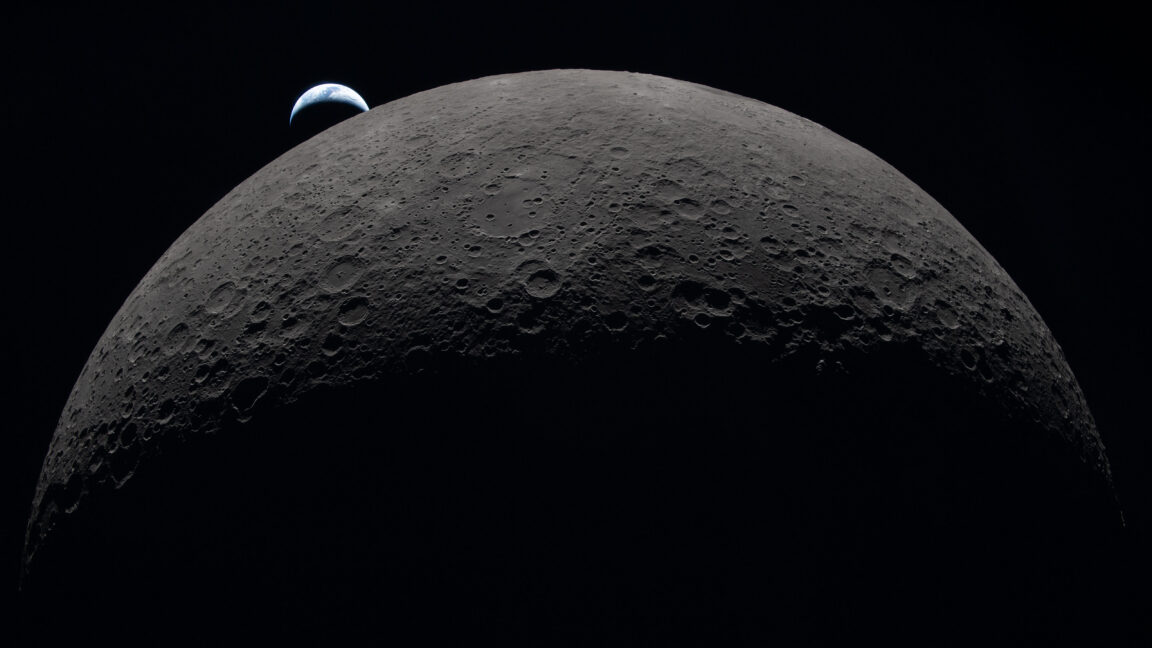
On Monday night, as the Orion spacecraft Integrity emerged from the radio silence of the lunar far side, it did more than re-establish contact with mission control — it opened a high-bandwidth firehose. Utilizing a laser communications link, the crew of Artemis II began transmitting a cache of high-resolution imagery back to Earth, a digital bridge spanning roughly a quarter-million miles of void. While the Moon has long been mapped by robotic sensors, these new frames offer something fundamentally different: the subjective perspective of human witnesses, the first to see the lunar far side with their own eyes.
The imagery released by NASA on Tuesday was captured not only by the spacecraft's automated arrays but by the astronauts themselves. Using handheld Nikon cameras and off-the-shelf iPhones, Reid Wiseman, Victor Glover, Christina Koch, and Jeremy Hansen documented their transit through the lunar neighborhood. There is a specific texture to these shots — captured through wide-angle and telephoto lenses — that deviates from the clinical perfection of satellite data. They represent the first human-eye views of the lunar surface in over half a century, since the final Apollo missions of the early 1970s.
The mission is now in its final act. Having reached their farthest point from Earth, the four astronauts are accelerating toward a Friday evening splashdown. As they prepare for the physical toll of reentry, the data they have sent ahead serves as a prelude to their return.
The laser link and the bandwidth problem
For decades, deep-space communication relied on radio frequencies — reliable but constrained in the volume of data they could carry. Optical, or laser, communications represent a generational shift. By encoding data in infrared light rather than radio waves, laser terminals can achieve dramatically higher throughput over the same distances. NASA has been developing this capability for years; the agency's DSOC (Deep Space Optical Communications) technology demonstration, tested during the Psyche mission, proved the concept viable well beyond Earth orbit.
Artemis II's use of laser communications is significant not merely as a technical milestone but as an operational prerequisite for the broader Artemis program. Future missions — lunar surface operations, habitat construction, eventual sustained presence — will generate volumes of scientific and engineering data that legacy radio links cannot efficiently handle. The firehose of imagery from Integrity is, in this sense, a proof of infrastructure as much as a moment of public spectacle. The capacity to move large files from cislunar space to Earth in near real-time changes the texture of what crewed missions can deliver to researchers and the public alike.
The case for the human vantage point
The question embedded in the Artemis II imagery is not new, but it has sharpened with time: in an era of autonomous rovers, orbital mappers, and AI-driven analysis, what does a human observer add? The Lunar Reconnaissance Orbiter has been photographing the Moon in extraordinary detail since 2009. The entire lunar surface is navigable through commercial mapping tools. No crater documented by the Artemis II crew will be unknown to planetary scientists.
Yet the history of space exploration suggests that the value of crewed missions has never been purely cartographic. The Apollo program's most enduring legacy may not be any single geological sample but the photograph known as "Earthrise" — an image captured by astronaut William Anders during Apollo 8 that reframed humanity's relationship with its own planet. That photograph was not on the mission plan. It was a product of human instinct: the impulse to look up, reframe, and shoot.
The Artemis II crew's handheld photography operates in the same tradition. The choice of what to frame, when to zoom, where to linger — these are editorial decisions that no pre-programmed sensor array replicates. Whether that editorial layer justifies the cost and risk differential between crewed and uncrewed missions remains one of the central tensions in space policy. Robotic missions are cheaper, safer, and increasingly capable. Crewed missions carry political weight, cultural resonance, and the irreducible unpredictability of human judgment.
As Integrity closes the distance to Earth ahead of splashdown, the images it has transmitted will circulate widely. They will be compared — inevitably — to the Apollo photographs that preceded them by more than fifty years. The technical gulf between the two eras is vast. The underlying question is not. Sending humans beyond low Earth orbit remains an extraordinarily expensive proposition. Whether the returns are scientific, strategic, or something harder to quantify — a renewed sense of perspective, perhaps — is a judgment each stakeholder will weigh differently.
With reporting from Ars Technica Space.
Source · Ars Technica Space