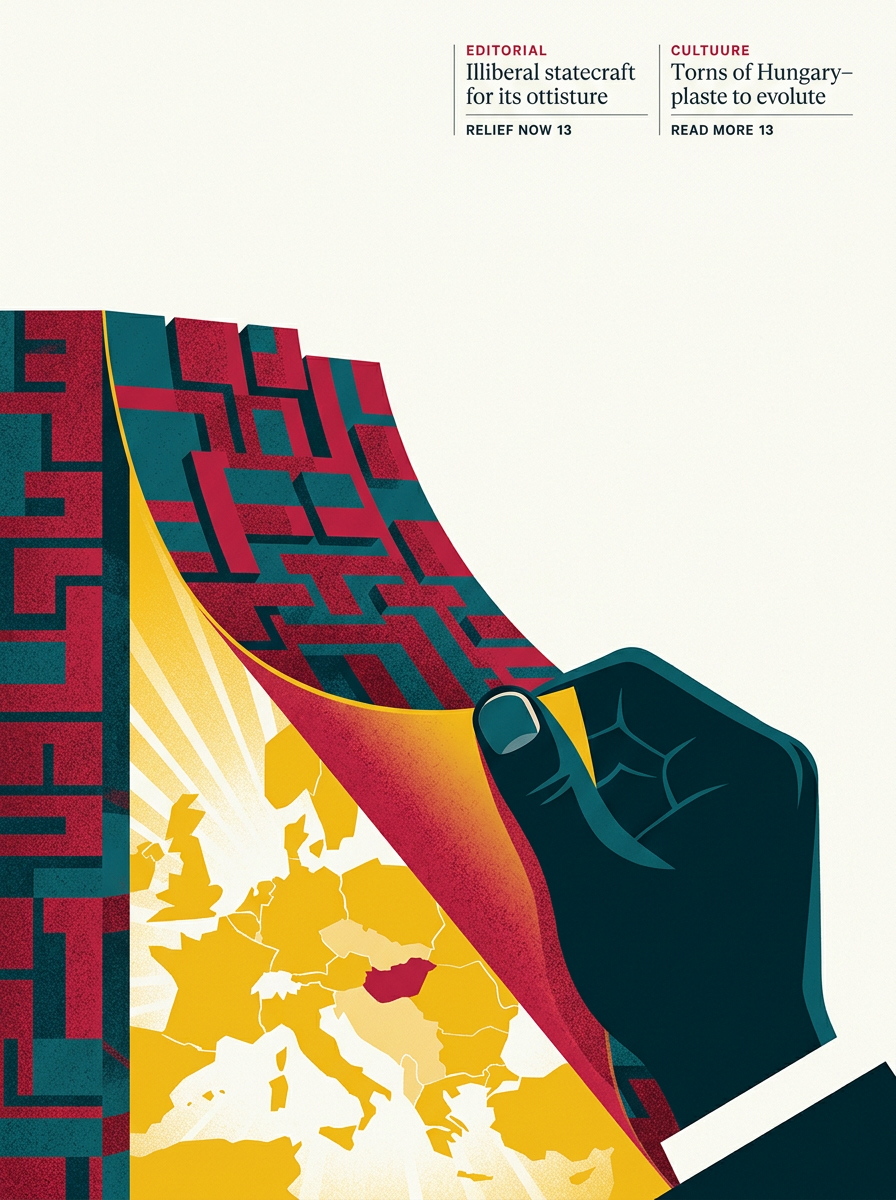
The recent electoral shift in Hungary has arrived with a decisiveness that few observers — even those skeptical of Viktor Orbán's longevity — fully anticipated. The opposition's ascent to a two-thirds supermajority provides more than just a change in leadership; it offers a rare constitutional mandate to dismantle the architecture of the "illiberal state" that Orbán spent over a decade constructing. In a region where democratic backsliding has often appeared irreversible, the result raises a pointed question: whether the populist tide in Central Europe is an enduring feature of the political landscape or a cycle now reaching its exhaustion point.
The collapse of the Fidesz government was accelerated by a series of strategic miscalculations and external pressures. The presence of U.S. Vice President JD Vance, reportedly attempting to frame the discourse around foreign influence, struck voters as an absurd irony — a foreign intervention warning against foreign intervention. Meanwhile, opposition figure Peter Magyar successfully leveraged Vladimir Putin's overt interference to invoke historical memories of Russian aggression, effectively neutralizing the nationalist appeal that had long served as Orbán's primary defense.
The mechanics of illiberal dismantlement
A two-thirds majority in Hungary's National Assembly is not merely a comfortable governing position. Under the Fundamental Law enacted by Fidesz in 2011, a supermajority is the threshold required to amend the constitution itself. Orbán used precisely this mechanism to reshape the judiciary, pack the Constitutional Court, restructure media ownership, and entrench loyalists across independent institutions. The opposition now holds the same lever — in reverse.
The challenge, however, is that dismantling an illiberal state is structurally harder than building one. Orbán's constitutional changes were designed with ratchet effects: institutional appointments with long terms, media conglomerates transferred to allied foundations, and electoral rules redrawn to favor incumbents. Reversing these arrangements requires not only legislative power but sustained political will and administrative capacity. Poland's experience after the 2023 parliamentary elections offers a partial precedent. There, the incoming coalition led by Donald Tusk encountered persistent resistance from a judiciary and presidency still aligned with the outgoing Law and Justice party. The lesson from Warsaw is that legal authority and operational control are not the same thing.
Hungary's new government will also face the question of democratic legitimacy in its methods. Using supermajority power to undo supermajority-enacted changes is constitutionally symmetrical but politically fraught. Critics will inevitably frame aggressive institutional reform as its own form of overreach. How the opposition navigates this tension — between urgency and restraint — will determine whether the transition is perceived as democratic restoration or partisan consolidation.
Geopolitical aftershocks across the continent
The ripples of the Hungarian result will be felt most acutely in Brussels and Bratislava. With Orbán sidelined, Slovakian Prime Minister Robert Fico loses his most critical ally within the European Union. For years, the Budapest-Bratislava axis functioned as a blocking minority on key EU decisions, from sanctions policy to rule-of-law conditionality. That axis is now broken.
The practical implications are significant. The EU's unanimity requirement on foreign policy and certain institutional matters has long been a source of paralysis, with Hungary wielding its veto to shield Russian interests and slow Ukraine's integration. A cooperative Hungarian government removes the most persistent obstacle to collective action on these fronts. The path toward Ukrainian and Moldovan accession into the European project — already a stated priority for the European Commission — becomes materially less obstructed.
For the broader populist movements across the continent, the signal is ambiguous but uncomfortable. Orbán was not merely a national leader; he was the intellectual anchor of a transnational illiberal project, hosting CPAC conferences in Budapest and positioning Hungary as proof that a post-liberal democracy could function within the EU framework. That proof of concept has now been revoked by Hungarian voters themselves.
The question that remains open is whether this represents a durable realignment or a pendulum swing within a volatile electorate. Central European politics has demonstrated a capacity for rapid reversals. The forces that sustained Orbán for fourteen years — economic grievance, cultural conservatism, distrust of Brussels — have not vanished with a single election. They have merely lost their vehicle. Whether the opposition can govern effectively enough to prevent their return is the tension that will define Hungarian politics for the next parliamentary cycle — and, by extension, the stability of the EU's eastern flank.
With reporting from Crooked Timber.
Source · Crooked Timber