The history of mid-century modernism is often a chronicle of objects that were too large to be kept but too significant to be truly destroyed. In Detroit, the work of Harry Bertoia — the Italian-born sculptor, designer, and sound artist — is undergoing a literal and metaphorical resurrection. A 26-foot suspended sculpture, commissioned in 1970 and long presumed lost to the wrecking ball, has resurfaced from a basement to anchor a new retrospective at the Cranbrook Academy of Art, the institution where Bertoia first developed his artistic vocabulary nearly a century ago.
The piece was originally commissioned by the J.L. Hudson Company for the Genesee Valley mall in Flint, Michigan. A gestural arrangement of steel-wire rods coated in melted brass and bronze, the sculpture embodies Bertoia's signature synthesis of industrial materials and organic form. After being moved to the Northland Mall in 1980, it vanished from public view, eventually becoming a ghost of the building's subsequent demolition. It was only in 2017 that members of the Southfield Arts Commission discovered the work languishing in a basement during a routine inspection.
A career between furniture and sculpture
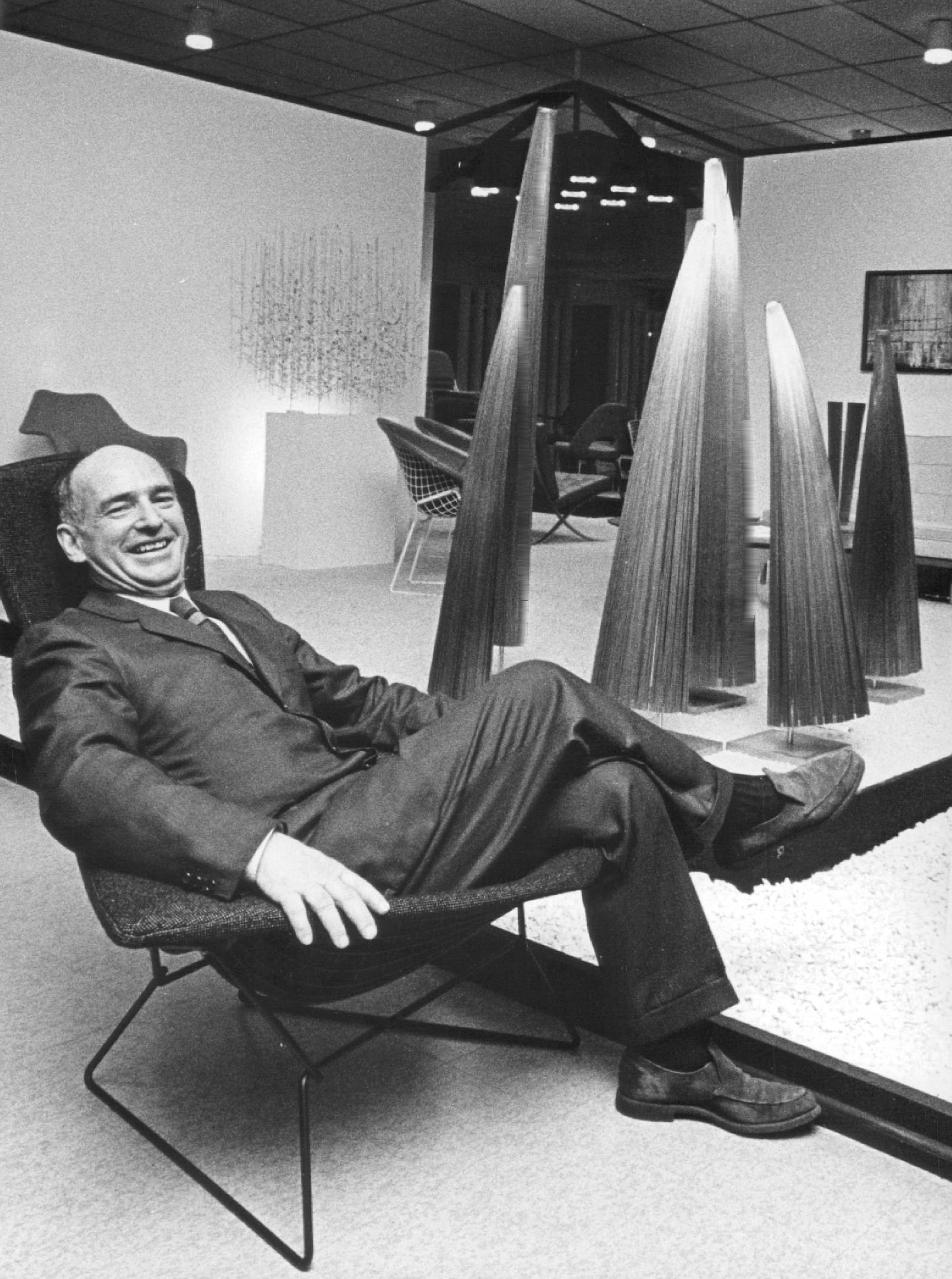
Bertoia arrived at Cranbrook in the 1930s as a student, entering an environment that functioned as a hothouse for American design. The academy's campus in Bloomfield Hills, Michigan, had already attracted figures such as Charles and Ray Eames and Florence Knoll, all of whom would go on to define the visual grammar of postwar domestic life. Bertoia initially trained in metalwork and jewelry, but his ambitions extended well beyond the decorative. His wire-frame "Diamond Chair," produced for Knoll in the early 1950s, became one of the most recognizable pieces of mid-century furniture — a chair that looked more like a drawing in space than a functional seat. The royalties from that design gave Bertoia the financial freedom to devote himself to sculpture full-time, and he spent the following decades producing large-scale commissions for corporate lobbies, civic buildings, and public plazas across the United States.
His sculptural language drew on the same material logic as his furniture: thin metal rods, welded or bundled, arranged to catch light and respond to air currents. In his later years, Bertoia became increasingly absorbed by the acoustic properties of his work, creating what he called "sonambient" sculptures — clusters of metal rods that produced tonal vibrations when touched or moved by wind. These pieces occupied a space between visual art, music, and architecture that remains difficult to categorize.
Public art and the fragility of institutional memory
The rediscovery of the Genesee Valley sculpture underscores a broader pattern in the fate of site-specific public art in the American Midwest. During the postwar decades, shopping malls and corporate campuses commissioned ambitious works from leading artists and architects, embedding them into structures designed for commercial use. When those structures lost economic viability — as many regional malls did beginning in the 1990s — the art they housed often disappeared along with them. Demolition crews rarely distinguish between structural steel and sculptural steel. The fact that Bertoia's piece survived at all owes more to chance and the diligence of a local arts commission than to any systematic preservation effort.
This retrospective at Cranbrook coincides with the 90th anniversary of Bertoia's arrival at the academy, a detail that lends the exhibition a sense of institutional homecoming. It also arrives at a moment when museums and collectors have shown renewed interest in Bertoia's sonambient works and large-scale sculptures, with prices at auction rising steadily over the past decade.
The tension, however, is structural rather than sentimental. Bertoia's career illustrates a model of artistic practice deeply embedded in mid-century institutional patronage — corporate commissions, university campuses, civic infrastructure. That ecosystem has largely dissolved. The question the Cranbrook retrospective implicitly raises is not simply whether Bertoia deserves renewed attention — the rediscovered sculpture makes that case on its own — but whether the conditions that enabled work of this scale and ambition to exist in public space can be reconstituted, or whether the basement in Southfield represents the more honest monument to how American culture treats its own material legacy.
With reporting from Hyperallergic.
Source · Hyperallergic