The return of the Artemis II mission is less a choice and more a physical certainty. As the Orion spacecraft approaches Earth's atmosphere, it is bound by the relentless mechanics of orbital physics. Even if the four astronauts on board were to discover a technical flaw at this late hour, the momentum of their trajectory ensures an inexorable descent. They are coming home, one way or another, with a predicted splashdown at 8:07 pm ET in the waters off Southern California.
This final 14-minute plunge is arguably the most critical phase of the lunar flight. During reentry, the spacecraft must shed thousands of miles per hour of velocity, converting kinetic energy into a localized inferno. The heat shield will be subjected to temperatures that test the very limits of materials science, acting as the sole barrier between the vacuum-sealed crew and the ionized plasma of the upper atmosphere. It is a period of forced silence and high stakes, where the engineering of the past decade meets its ultimate validation.
The Physics of Coming Home
Reentry from lunar distance is a qualitatively different problem from returning from low Earth orbit. Spacecraft arriving from the Moon enter the atmosphere at roughly 40,000 kilometers per hour — significantly faster than vehicles returning from the International Space Station. That additional velocity compounds the thermal and aerodynamic loads on every surface of the capsule. The margin for error in the entry corridor narrows accordingly: too steep an angle and the crew faces deceleration forces beyond human tolerance; too shallow and the capsule skips off the atmosphere like a stone on water, potentially into an unrecoverable trajectory.
Orion's heat shield, the largest of its kind ever built for a crewed spacecraft, uses an ablative material called AVCOAT. The compound is designed to char and erode in a controlled fashion, carrying heat away from the structure as it disintegrates. The technology traces its lineage to the Apollo program, though the scale and manufacturing process differ substantially. During the uncrewed Artemis I mission, the heat shield performed its primary function but exhibited unexpected patterns of material loss — a finding that prompted extensive review and analysis before NASA cleared Artemis II to fly with crew aboard.
The communications blackout that accompanies reentry adds a layer of operational tension. As ionized gas envelops the capsule, radio signals cannot penetrate the plasma sheath. For several minutes, ground controllers and the crew are severed from one another entirely. Mission control can model, predict, and simulate — but it cannot intervene. The spacecraft is, in the most literal sense, on its own.
From Freefall to Splashdown
Once Orion decelerates through the atmosphere and emerges from the blackout zone, a carefully choreographed parachute sequence begins. The system involves drogue chutes to stabilize the capsule and slow its descent, followed by the deployment of three main parachutes that bring the vehicle to a survivable impact speed on the water's surface. Parachute systems are among the most mechanically unforgiving components in spaceflight — they must deploy in precise sequence under extreme aerodynamic stress, and redundancy only partially mitigates the consequences of failure.
The planned recovery zone off the coast of Southern California places the capsule within reach of U.S. Navy assets staged for retrieval. The choice of a Pacific splashdown echoes Apollo-era operations, when the Navy routinely plucked returning crews from the ocean. For Artemis II, the recovery marks the first time since Apollo 17 in 1972 that astronauts will be fished from the sea after a voyage beyond low Earth orbit.
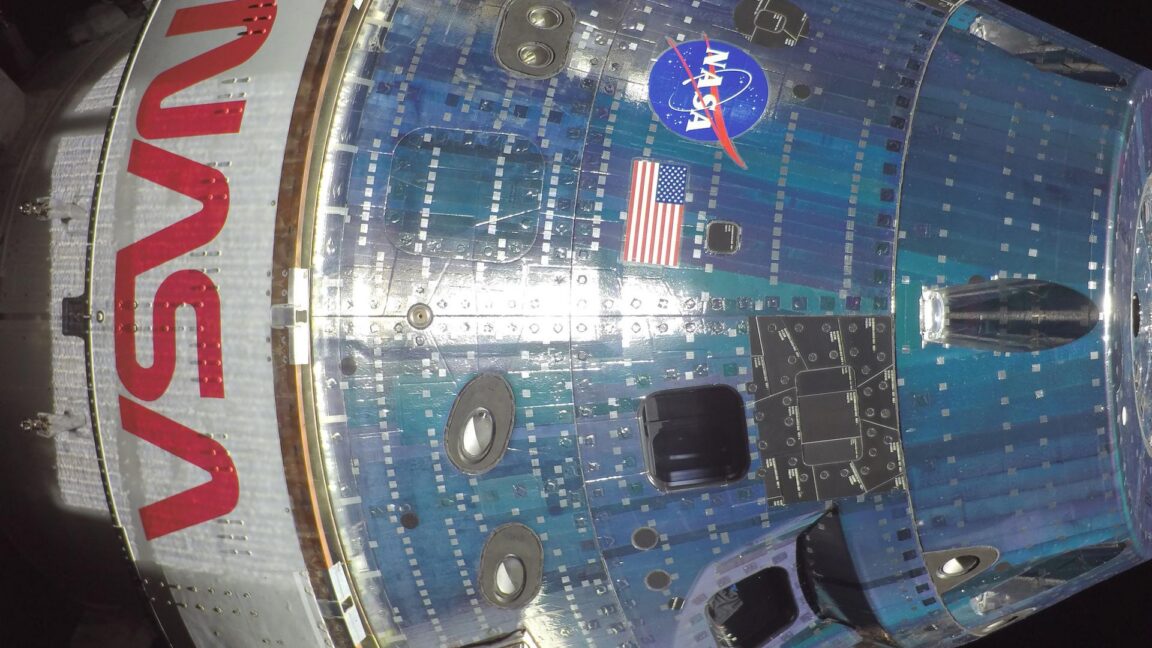
While recent imagery reviewed by NASA suggests the vehicle remains in peak condition, the transition from deep space to the Pacific Ocean is never routine. The sequence of events compressed into those final minutes — thermal survival, aerodynamic control, parachute deployment, water impact — represents the closing movement of a complex orbital chain, each link forged years in advance and tested only once in the conditions that matter.
For the crew and the ground teams watching from the coast, the question is not whether the physics will deliver Orion to the ocean. It will. The question is whether every engineered system performs within the tolerances that separate a successful splashdown from something else entirely — and that answer arrives only when the parachutes open against the California sky.
With reporting from Ars Technica Space.
Source · Ars Technica Space