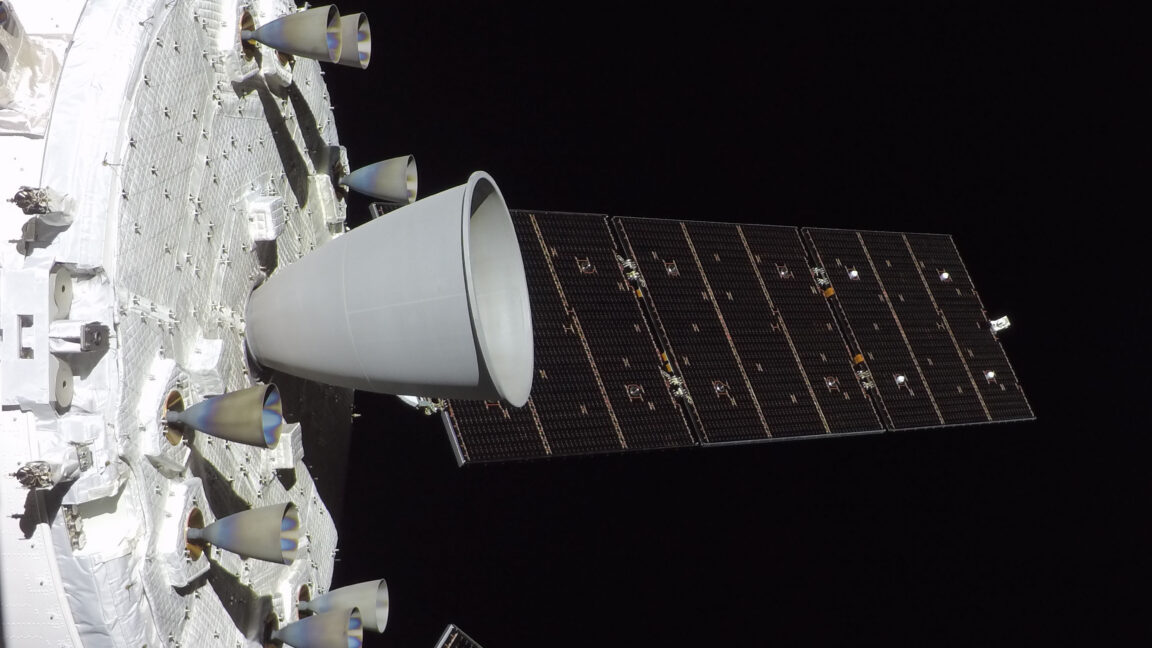
As the Orion spacecraft, christened Integrity, hurtles back toward Earth following its lunar flyby, the Artemis II mission has entered a phase of pragmatic troubleshooting. While the journey has been largely successful — save for persistent malfunctions in the waste disposal system — ground controllers shifted the flight timeline on Wednesday. A planned manual piloting demonstration, intended to showcase the crew's ability to maneuver the craft independently, was scrapped in favor of a more urgent diagnostic task: investigating a leak in the spacecraft's propulsion system.
The issue centers on a "small leak" of helium, the inert gas used to pressurize propellant tanks and feed the spacecraft's engines. According to Jeff Radigan, NASA's lead flight director, the decision to prioritize data collection over the manual demonstration reflects a need to understand the leak's mechanics before the craft enters the atmosphere. While the leak poses no immediate risk to the four astronauts currently aboard, it represents a significant engineering hurdle for the Artemis program's long-term viability — and one that will almost certainly require hardware changes before Orion flies again.
A familiar problem in a new context
Helium leaks are among the most persistent nuisances in spaceflight engineering. Because helium atoms are extraordinarily small, they can migrate through seals and joints that would contain larger molecules without issue. Pressurization systems across the aerospace industry — from launch vehicles to orbital service modules — have contended with this reality for decades. The challenge is not that helium leaks occur, but that they must be kept within tolerances narrow enough to ensure mission safety across extended flight profiles.
For Orion, the stakes are compounded by the program's architecture. Unlike low-Earth-orbit vehicles that can be serviced or deorbited relatively quickly, Orion is designed for missions lasting weeks in deep space, far beyond the reach of any rescue capability. A propulsion system leak that is manageable over a ten-day lunar flyby could become operationally disqualifying on a longer mission to the lunar surface or a sustained presence in lunar orbit. The margins for degradation shrink as mission duration grows.
The cancellation of the manual piloting demonstration is itself a telling signal. That exercise was designed to validate crew autonomy in maneuvering the spacecraft — a capability considered essential for contingency scenarios where communication with ground control is delayed or disrupted. Sacrificing it suggests that mission planners judged the diagnostic value of leak characterization to outweigh the operational value of the piloting test, at least on this flight. The piloting demonstration can be rescheduled; a propulsion redesign cannot begin without data.
Redesign before the next step
The broader implication extends well beyond Artemis II. NASA's Artemis program depends on Orion as its sole crew vehicle for deep-space transit. Any redesign of the propulsion system's valve architecture or pressurization plumbing would ripple through the production and testing schedule for Artemis III, the mission intended to return astronauts to the lunar surface for the first time since Apollo 17 in 1972. Hardware changes at this stage of a program are neither unusual nor catastrophic, but they carry schedule and cost consequences that compound quickly.
The Artemis program has already absorbed significant delays driven by development challenges with the Space Launch System, the Orion heat shield, and the Human Landing System contracted to SpaceX. Each delay has tested political and institutional patience. A propulsion valve redesign adds another variable to a timeline that has little remaining slack.
Still, the decision to prioritize diagnostics over demonstration reflects a discipline that has not always characterized high-profile NASA programs. The instinct to declare success and address problems later has, historically, produced far worse outcomes than the instinct to pause and understand. The data Integrity collects on its return leg will shape the engineering path forward — whether that means a targeted valve replacement, a broader pressurization system overhaul, or a revised operational envelope that accounts for acceptable leak rates.
As Integrity prepares for splashdown, the mission's legacy is taking shape not as a triumphant lunar flyby but as a diagnostic proving ground. The tension between programmatic momentum and engineering rigor is one NASA has navigated before, with mixed results. Whether the agency treats this leak as a problem to be solved quickly or a signal to be studied thoroughly will say as much about the Artemis program's trajectory as any flight demonstration could.
With reporting from Ars Technica Space.
Source · Ars Technica Space