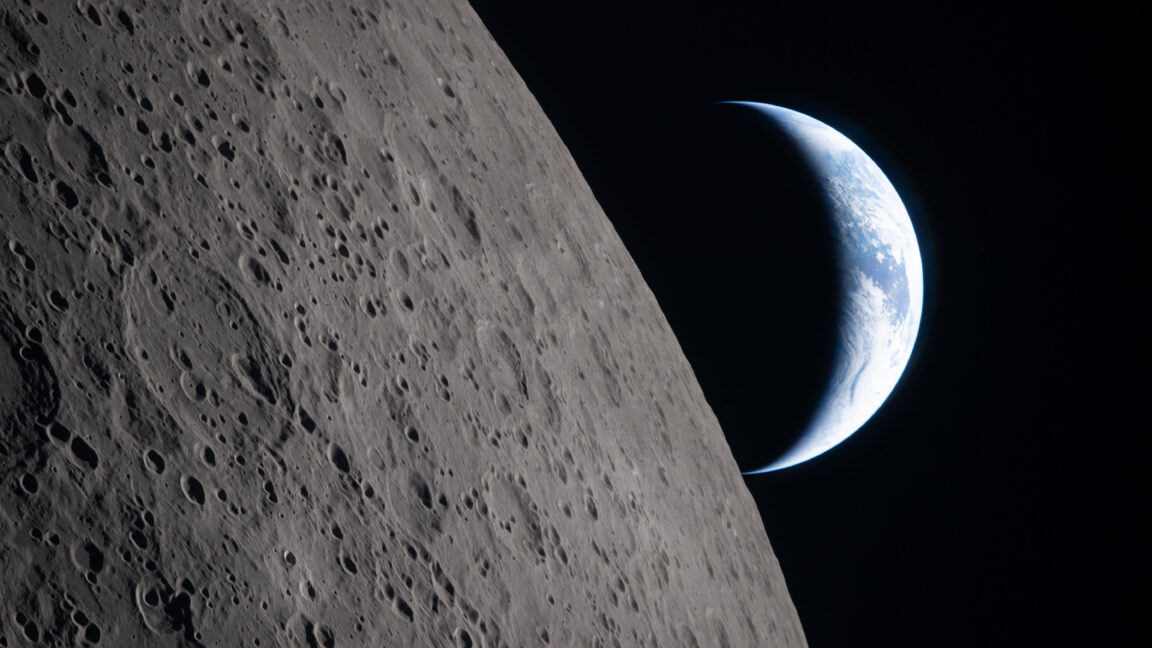
For nearly eight hours on Monday, Reid Wiseman, the commander of NASA's Artemis II mission, found himself at the limits of description. As the Orion spacecraft drew closer to the lunar surface than any human-rated vessel in over half a century, the 50-year-old Navy test pilot struggled to reconcile the physical reality outside his window with the data on his displays. "No matter how long we look at this, our brains are not processing this image in front of us," Wiseman remarked, describing the view as "absolutely spectacular" yet fundamentally surreal.
The mission, which carries a crew of four on a trajectory around the Moon, represents a significant milestone in the return to deep-space exploration. While live video feeds from external GoPro cameras provided the public with a low-resolution glimpse of the lunar approach — constrained by the narrow bandwidth available from such vast distances — the crew spent the night downlinking sharper telephoto imagery. These high-fidelity snapshots are expected to offer a more clinical, detailed look at a landscape that, for the moment, remains almost incomprehensible to those seeing it in person.
A Record Measured in Silence
Artemis II marks the first time humans have traveled beyond low Earth orbit since Apollo 17 in December 1972. That gap — more than five decades — is the longest hiatus in the history of crewed exploration beyond the immediate vicinity of Earth. The Apollo program sent a total of 24 astronauts to lunar distance across nine missions between 1968 and 1972, and the cultural memory of those flights has shaped public expectations of what a return would look like. Yet the context has shifted. Apollo was a Cold War sprint; Artemis is framed as the opening phase of a sustained presence, with subsequent missions intended to deliver crews to the lunar surface and eventually support longer-duration stays.
The distance record set by the Artemis II crew adds a quantitative footnote to a qualitative experience. Orion's free-return trajectory carried the capsule around the far side of the Moon, a region no human eyes have observed directly since the Apollo era. The far side lacks the dark maria — the vast basaltic plains — that dominate the near side's appearance from Earth. Instead, it presents a densely cratered, almost uniformly bright terrain that offers few familiar visual anchors. For a crew trained extensively on orbital mechanics and spacecraft systems, the absence of intuitive scale cues appears to have been genuinely disorienting.
Wiseman's struggle to find the right adjectives underscores the psychological shift inherent in this new era of spaceflight. Astronauts aboard the International Space Station routinely describe Earth in terms that, while awed, draw on a shared visual vocabulary — coastlines, storms, city lights at night. The Moon offers no such lexicon. It is a world without atmosphere, without color gradation at the horizon, without weather. The terminator line between sunlight and shadow is abrupt rather than graduated. Depth perception, which on Earth relies partly on atmospheric haze, loses one of its primary inputs.
From Symbol to Geography
The broader significance of the crew's reaction may lie in what it signals about the transition ahead. For most of human history, the Moon has functioned as an abstraction — a navigational reference, a poetic symbol, a geopolitical trophy. The Apollo photographs began to change that, but the program ended before the Moon could become a working destination. Artemis is premised on completing that conceptual shift: turning the Moon from an object into a place.
That shift carries operational implications. Future Artemis surface missions will require crews to navigate terrain that, as Wiseman's comments suggest, resists easy cognitive mapping. Habitat design, EVA planning, and even crew psychological preparation may need to account for a landscape that the human perceptual system did not evolve to parse. The challenge is not merely engineering — it is epistemic.
The tension embedded in Artemis II sits between the program's technical success and the deeper question it surfaces. The spacecraft performed. The trajectory held. The crew is safe. But the astronauts' own testimony suggests that the Moon, even from orbit, remains a place that exceeds the frameworks brought to describe it. Whether that gap narrows as more humans make the journey — or whether it proves to be a durable feature of lunar experience — is a question that subsequent missions will test but may not resolve.
With reporting from Ars Technica Space.
Source · Ars Technica Space