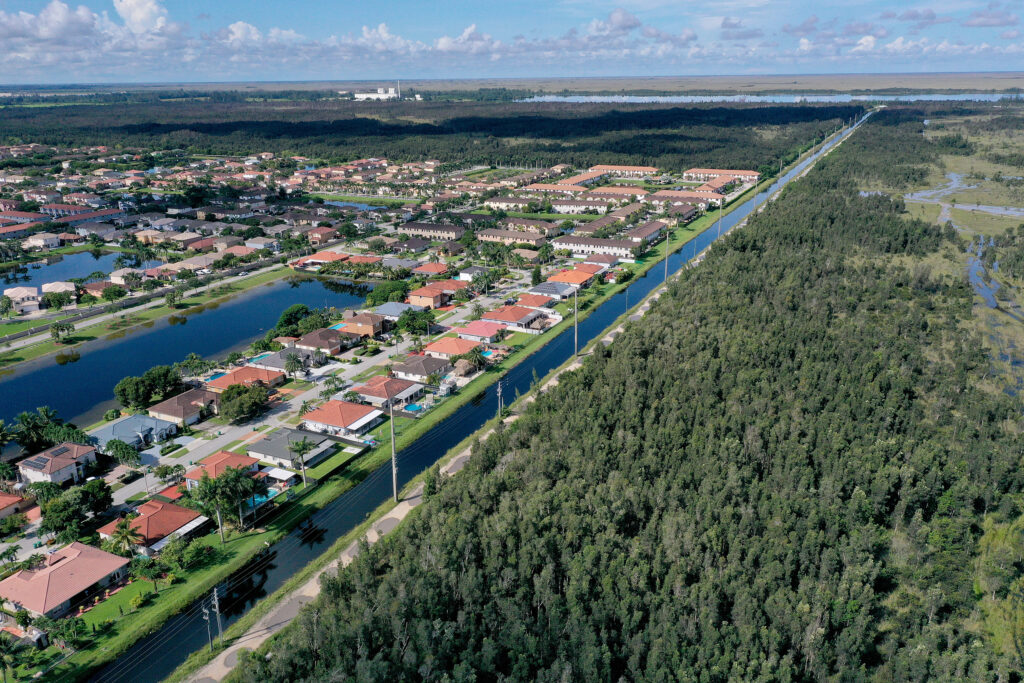
For nearly forty years, the Florida Everglades — the vast, slow-moving "river of grass" stretching across the southern tip of the peninsula — has been the subject of one of the most ambitious environmental restoration projects in American history. Yet, according to a new report, the ecosystem is not on track to meet a critical water quality standard set to take effect next month. The findings underscore the persistent difficulty of reversing decades of agricultural runoff and industrial pollution in a landscape defined by its ecological fragility.
The restoration efforts have long focused on reducing phosphorus levels, a byproduct of fertilizer use in the sugar and agriculture industries that dominate the lands upstream of the Everglades. Excess phosphorus disrupts the delicate balance of native flora — particularly the periphyton mats, thin layers of algae and microorganisms that form the base of the Everglades food web. When phosphorus concentrations rise, invasive cattails crowd out the sawgrass and other species that define the ecosystem's character. Despite the deployment of massive stormwater treatment areas — engineered filtration marshes designed to absorb phosphorus before water enters the protected wetlands — the report suggests that current progress remains insufficient to meet the looming legal benchmarks.
Four Decades of Engineering Against Entropy
The Everglades restoration effort traces its formal origins to the Comprehensive Everglades Restoration Plan, authorized by Congress in 2000, though state-level interventions began even earlier. The project was conceived as a multi-decade, multi-billion-dollar endeavor to undo the damage wrought by a century of drainage, canal-building, and agricultural expansion that had reduced the original Everglades to roughly half its historic extent. The scale of the undertaking has few parallels in environmental policy — a recognition that the Everglades serves not only as a biodiversity reservoir but as the primary water supply system for millions of South Florida residents.
The challenge, however, has always been structural. The Everglades sits downstream of the Everglades Agricultural Area, a region of intensive sugar cane and vegetable farming whose nutrient-laden runoff flows south through a managed network of canals and levees. Reducing phosphorus at the source would require fundamental changes to agricultural practice; filtering it after the fact demands infrastructure that must function at enormous scale and over indefinite time horizons. The stormwater treatment areas built to date represent significant engineering achievements, yet the gap between intention and outcome highlights a recurring pattern in large-scale environmental remediation: the difficulty of achieving absolute thresholds rather than merely incremental improvement.
The Politics of Measurement
Florida state officials offer a more optimistic reading of the situation, contending that recent data indicates pollution levels are nearing the established limits. This discrepancy between the report's conclusions and the state's interpretation points to a deeper tension in environmental governance — one that extends well beyond the Everglades. How progress is measured, over what time frame, and against which baseline are questions that carry enormous regulatory and political weight. A trend line moving in the right direction can look like success or failure depending on whether the standard is relative improvement or absolute compliance.
The Everglades case also illustrates the compounding pressures that climate change introduces to legacy restoration projects. Rising sea levels push saltwater further into the freshwater system, altering the hydrology that restoration plans were designed around. More intense storm cycles redistribute nutrients in ways that engineered filtration marshes were not built to handle. The restoration framework, conceived in an era when climate projections were less central to infrastructure planning, now contends with variables that shift the goalposts even as the original targets remain unmet.
The coming months will serve as a concrete test: whether forty years of investment, engineering, and political negotiation can bring the Everglades into compliance with the standards that were meant to mark a turning point. But the deeper question may be whether compliance itself is a sufficient measure of restoration — or whether the Everglades, caught between agricultural economics, urban growth, and a changing climate, represents a case where the forces acting on a landscape simply outpace the capacity of policy to hold them in balance.
With reporting from Inside Climate News.
Source · Inside Climate News