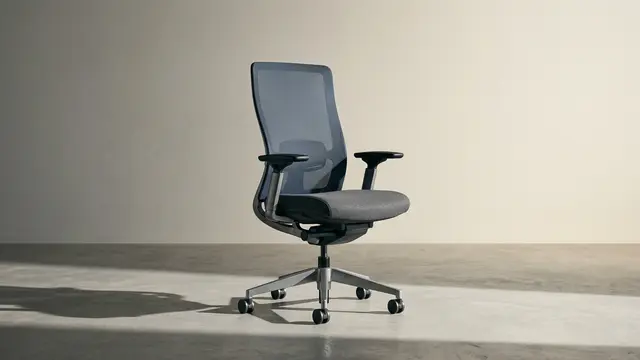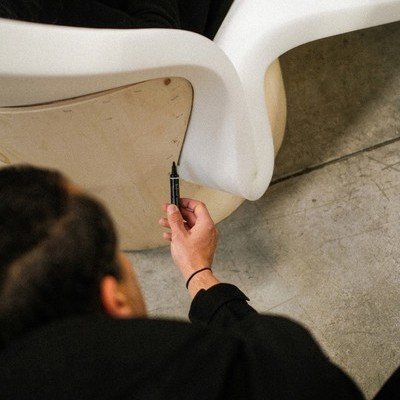
In the traditional grammar of furniture making, upholstery is an act of concealment. Fabric and foam are typically bound to wooden or metal frames through a hidden architecture of adhesives, staples, and tacks — fasteners that are effective but often render the piece difficult to repair or recycle. London-based industrial design studio Raw Edges, led by Yael Mer and Shay Alkalay, has introduced an experimental chair that seeks to eliminate these permanent bindings in favor of a simpler, mechanical logic: friction.
The studio's approach centers on a wooden frame featuring a deep, purposeful notch. Rather than being nailed or glued into place, the upholstered cushion is simply wedged into this gap. The assembly relies entirely on friction to keep the components secure, creating a structural tension that serves as both the functional core and the primary aesthetic detail of the piece. No adhesive, no staple gun, no hidden tack strip — just the calculated interference between two volumes pressed together.
Friction as a Design Principle
The idea of using friction as a primary joinery mechanism is not new in woodworking. Japanese timber framing has relied on interlocking joints without nails or glue for centuries. Press-fit and wedge-based connections appear across vernacular furniture traditions from Scandinavia to West Africa. What distinguishes the Raw Edges chair is the application of this principle specifically to the upholstery-frame interface — a junction that modern manufacturing has almost universally resolved with permanent fasteners.
The notch in the wooden frame functions as a kind of mechanical clamp. The geometry must be precise enough to grip the cushion firmly under normal use while still allowing deliberate disassembly. This is a narrow engineering corridor: too loose, and the seat fails in service; too tight, and the promise of easy separation becomes theoretical. The success of the concept depends on tolerances that leave little room for error, which may explain why it remains, for now, in the territory of experimental design rather than mass production.
Stripping away adhesives and staples also changes the material hierarchy of the object. In conventional upholstered furniture, the frame is subordinate — a skeleton meant to disappear beneath padding and fabric. Here, the notched frame becomes the most legible element of the design. The joint is not hidden but celebrated, turned into the visual signature of the piece. It is a move that aligns Raw Edges with a broader current in contemporary design that treats construction logic as ornament.
Modularity and the Question of Longevity
The deeper implication of friction-fit upholstery is modularity. When a cushion can be removed without tearing fabric or dissolving glue, the lifecycle of each component becomes independent. A worn seat pad can be replaced without discarding the frame. A frame can be refinished without disturbing the textile. In principle, this extends the useful life of the object and simplifies end-of-life recycling — two concerns that have moved from the margins of furniture discourse toward its center as circular-economy frameworks gain regulatory traction in the European Union and elsewhere.
Yet modularity introduces its own tensions. Friction joints can loosen over time as materials compress, wear, or respond to changes in humidity. Upholstery foam degrades; wood moves seasonally. Whether a friction-fit connection can maintain its grip across years of domestic use — through the accumulated physics of sitting, shifting, and standing — is a question that prototyping alone cannot fully answer. Durability data requires time, and experimental furniture, by definition, has not yet had enough of it.
The Raw Edges chair sits at an intersection that furniture design revisits periodically: the desire to make construction legible and reversible, set against the practical demands of comfort and endurance. It is a proposition that the simplest physical forces — pressure, surface contact, gravity — can do the work that industrial adhesives have claimed for decades. Whether that proposition scales beyond the studio remains an open question, but the terms of the argument are clear. The answer depends less on design intent than on whether wood and foam, pressed together in a notch, can hold their grip long enough to prove the point.
With reporting from Core77.
Source · Core77