On Friday evening, the Orion spacecraft, christened Integrity, met the Earth's atmosphere at thirty times the speed of sound. This final, most precarious leg of the journey transformed the capsule into a kinetic torch, with exterior temperatures reaching 5,000 degrees Fahrenheit. For six minutes, a cocoon of superheated plasma severed all radio contact with Mission Control in Houston — a standard but harrowing silence that underscored the immense physical stakes of the first crewed lunar voyage in over half a century.
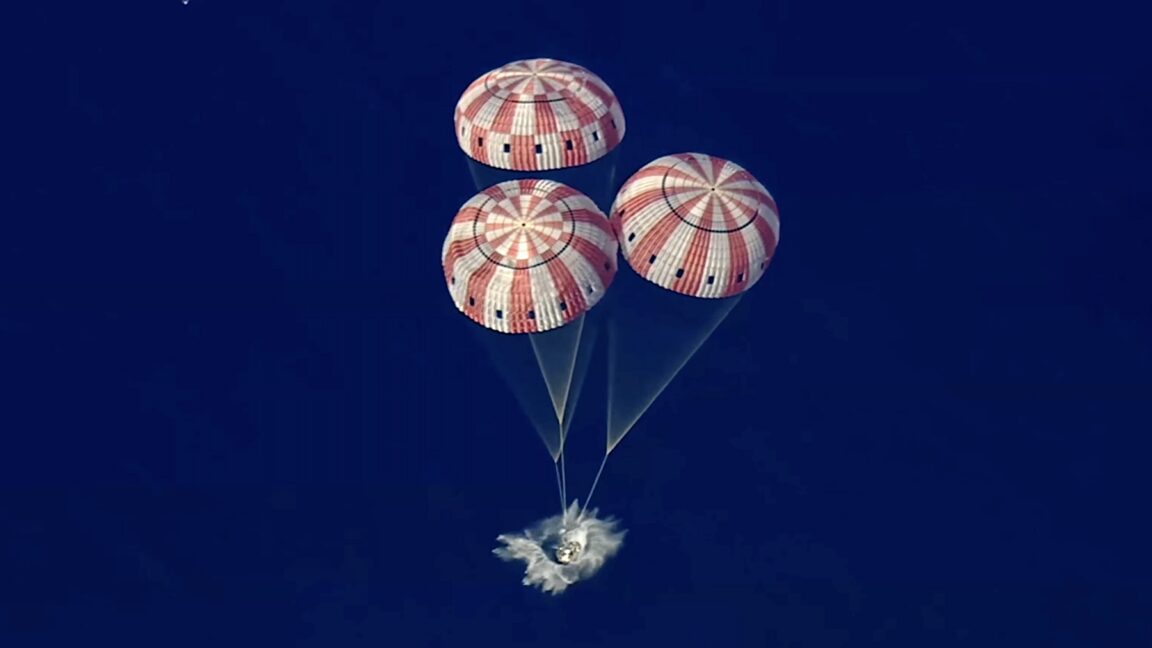
The mission, commanded by Reid Wiseman, represents more than a technical milestone; it is the restoration of a capability dormant since 1972. As the spacecraft arced from the southwest toward its splashdown zone near San Diego, tracking planes captured the mechanical choreography of its descent. The jettisoning of the parachute cover gave way to the deployment of three massive main chutes, their 10,500-square-foot canopies slowing the craft's plunge into the Pacific. Recovery by the U.S. Navy came at 8:07 pm EDT.
A Capability Rebuilt From Scratch
The last time human beings returned from the Moon, Richard Nixon was in the White House and the Apollo 17 crew splashed down in the South Pacific in December 1972. In the intervening decades, no crewed vehicle — American or otherwise — had been designed, tested, and flown to withstand the particular violence of a lunar-return re-entry, which subjects a spacecraft to speeds and thermal loads far exceeding those of a return from low Earth orbit. The International Space Station orbits at roughly 17,500 miles per hour; Orion arrived at the top of the atmosphere traveling closer to 25,000. That difference is not incremental. It demands a fundamentally different heat shield, a different trajectory management philosophy, and a different margin of error.
Orion's thermal protection system, the largest ablative heat shield ever built for a crewed spacecraft, had been tested on the uncrewed Artemis I flight, which circled the Moon without astronauts aboard. That mission provided data, but data without crew is a different category of confidence than data with four lives behind the shield. The successful return of Integrity closes that gap. It confirms that the engineering models, the ablation rates, and the skip-entry technique — in which the capsule briefly rises back out of the upper atmosphere before plunging in again, dissipating energy across two thermal events rather than one — perform as designed under operational conditions.
From Sprint to Sustained Presence
The Apollo program was conceived as a geopolitical demonstration, structured around a series of sorties: fly to the Moon, collect samples, return. Each mission was self-contained, and the program ended when the political impetus behind it faded. The Artemis architecture, by contrast, is designed around incremental buildup. Future missions are intended to deliver modules for the Gateway, a small orbital station planned for lunar orbit, and to establish surface infrastructure that would allow longer stays and broader scientific work.
Whether that architecture materializes as planned remains an open question. Large-scale programs of this kind are subject to budget cycles, shifting political priorities, and the technical realities of hardware that has yet to fly. The Space Launch System, the heavy-lift rocket that carried Integrity to orbit, faces ongoing scrutiny over cost and cadence. Commercial alternatives from the private launch sector continue to mature, raising questions about the long-term role of government-built vehicles in deep-space transportation.
What is no longer in question, after Friday's splashdown, is whether the United States can send astronauts to the Moon and bring them home. That capability now exists again, validated not by simulation but by the safe return of a crew through a corridor of plasma and heat. The harder question — whether the institutional and fiscal scaffolding exists to turn a single successful mission into a sustained program — is the one that the next several years will answer. The physics of re-entry are unforgiving but predictable. The politics of sustained exploration are neither.
With reporting from Ars Technica Space.
Source · Ars Technica Space