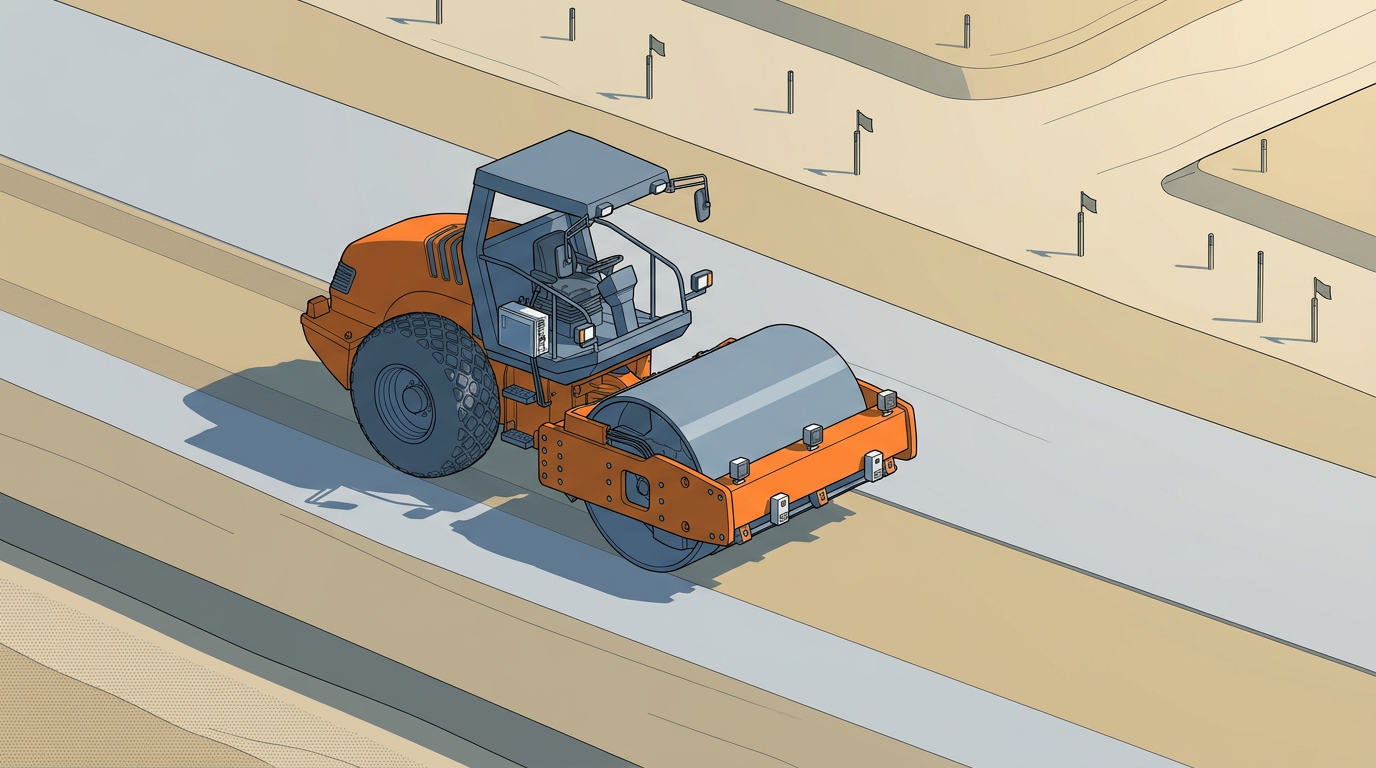
At a 30-acre airport extension in Austin, Texas, a standard drum roller recently completed a 30-day trial without a human behind the wheel. The machine, retrofitted with an aftermarket "robotic brain" developed by the startup Crewline, managed to reduce daily downtime from six hours to less than one. According to the contractor, Dynamic Site Solutions, the autonomous operation nearly doubled the machine's productive hours on-site while maintaining a perfect safety record.
The technology arrives at a moment of profound stagnation for the building trades. While U.S. manufacturing productivity has surged over the last 50 years due to automation and standardization, construction productivity has moved in the opposite direction, falling by more than 30% since 1970. Modular prefabrication has gained traction as a way to move labor into controlled factory environments, but the foundational work of earthmoving — grading, compaction, trenching — remains a stubbornly manual bottleneck in the real estate pipeline.
The aftermarket thesis
Crewline's approach is notably pragmatic and reflects a broader pattern in industrial automation: rather than replacing the installed base, augment it. The four-person startup offers a kit that can be installed on existing steamrollers in roughly an hour without cutting a single wire. This "plug-and-play" philosophy allows contractors to digitize their existing assets, turning analog rollers into intelligent agents capable of navigating complex job sites.
The strategy sidesteps one of the heaviest barriers to technology adoption in construction — capital expenditure. Heavy equipment represents enormous sunk cost for contractors, many of whom operate on thin margins and long depreciation schedules. Asking a mid-size earthworks firm to scrap a functioning fleet in favor of purpose-built autonomous machines is, in most cases, a non-starter. An aftermarket retrofit that preserves the existing asset while layering autonomy on top changes the calculus entirely. The model has a rough parallel in the automotive world, where companies have explored aftermarket self-driving kits rather than requiring consumers to buy entirely new vehicles, though construction's operating environment — slower speeds, repetitive patterns, geofenced sites — presents a considerably more tractable problem than open-road driving.
The distinction matters because construction sites, unlike public roads, are closed environments with predictable geometries. A drum roller performing compaction passes follows a defined pattern over a known surface. The task is repetitive by nature, which makes it a strong candidate for automation even with current sensor and navigation technology. The complexity lies less in the driving itself than in integrating autonomous operation into the messy, multi-trade choreography of a live job site.
Productivity's structural problem
Construction's productivity decline is not merely a technology gap. It reflects fragmented supply chains, adversarial contracting models, a persistent skilled-labor shortage, and regulatory environments that vary jurisdiction by jurisdiction. No single intervention — robotic or otherwise — resolves all of these simultaneously. What autonomy can address is the utilization rate of expensive equipment. Machines on construction sites spend a significant share of each shift idle: waiting for operators, pausing for shift changes, or sitting unused during breaks and overnight hours. If Crewline's Austin trial is representative, compressing that dead time offers a direct path to higher throughput without adding headcount or machines.
For CEO Frederik Filz-Reiterdank, the Austin results suggest a viable path forward for an industry that has long resisted the digital curve. By automating the most repetitive and time-consuming aspects of site preparation, the technology seeks to reconcile the slow, physical reality of construction with the efficiency of modern industrial design.
The harder question is whether the model scales beyond a single machine type on a single site. Drum rollers are among the simplest vehicles in the heavy-equipment taxonomy — they move slowly, follow predictable routes, and operate on relatively flat terrain. Excavators, graders, and dozers introduce degrees of freedom that are orders of magnitude more complex. Whether Crewline's kit architecture can extend across that spectrum, and whether contractors will trust it to do so, will determine whether this remains a clever niche product or the beginning of a genuine platform shift. The Austin trial opens the door. What walks through it is still an open question.
With reporting from Fast Company Design.
Source · Fast Company Design