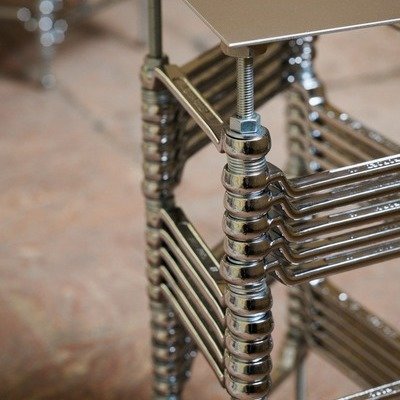
The offset wrench is an object shaped entirely by the demands of leverage and the constraints of tight spaces. Its angled jaw, its calibrated thickness, its open-and-ring-end geometry — every feature exists to solve a mechanical problem. For Japanese artist Iyo Hasegawa, however, the tool's utility is secondary to its potential as a modular building block. In her "Wrench" series, Hasegawa repurposes mass-produced steel implements into a collection of furniture that sits at the intersection of industrial surplus and sculptural rigor.
The construction method is deceptively straightforward. Hasegawa utilizes threaded rods as a central spine, threading them through the ring ends of stacked wrenches. By varying the orientation and the offset of each tool, she creates rhythmic, skeletal structures that function as table legs and supports. The repetitive stacking transforms a singular, utilitarian object into a complex, textured surface that feels both heavy and strangely delicate.
The Readymade, Reassembled
Hasegawa's work operates in a lineage that stretches back more than a century. When Marcel Duchamp placed a urinal on a pedestal in 1917 and titled it Fountain, the gesture was one of recontextualization: an industrial product, stripped of function, became art by declaration. The readymade tradition has since expanded through countless iterations — from the found-object assemblages of mid-century sculptors to the repurposed consumer goods of contemporary installation art. What distinguishes Hasegawa's approach is that her chosen object is not merely displayed but structurally deployed. The wrench does not sit on a pedestal; it becomes the pedestal. It bears weight. It holds a surface. The readymade is returned to function, though not its original one.
There is a quiet subversion in the choice of material. A wrench is a tool designed to assemble other things — to tighten bolts, to join components, to make structures hold. By using it as the structure itself, Hasegawa collapses the distinction between tool and product. The assembly becomes the final artifact. The means of making becomes the thing made.
This conceptual loop gives the work a self-referential quality that elevates it beyond furniture design or sculpture alone. It asks whether the identity of an object resides in its intended purpose or in the physical properties — mass, geometry, material — that make that purpose possible in the first place.
Geometry as Ornament
From a design standpoint, the series raises questions about modularity and repetition that resonate well beyond the art studio. Modular construction systems — from standardized bricks to slotted steel shelving — have long relied on the principle that a single repeated unit, arranged according to simple rules, can produce complex and stable forms. Hasegawa's wrenches follow the same logic. Each unit is identical; variation emerges from rotation, spacing, and the offset angle inherent in the tool's own geometry. The resulting texture is not applied or decorative. It is a direct consequence of the structural logic of the component itself.
This places the work in conversation with a broader tendency in contemporary design to treat raw industrial components as aesthetic elements rather than hidden infrastructure. Exposed fasteners, visible joinery, and unfinished steel have become recurring motifs in furniture and architecture that seeks honesty of construction. Hasegawa takes the principle further: the fastener is not merely visible but is the entire piece.
The material choice carries its own weight, both literally and culturally. Steel wrenches are products of industrial standardization — objects manufactured by the millions, designed to be interchangeable and anonymous. By accumulating them into singular, authored pieces of furniture, Hasegawa inverts the logic of mass production. Quantity becomes specificity. The generic becomes particular.
Whether the "Wrench" series points toward a scalable design methodology or remains a conceptual provocation is a tension the work does not resolve — and likely does not intend to. The furniture functions. It also resists easy categorization. That resistance, between the utilitarian and the sculptural, between the industrial and the handmade, between the readymade and the deeply considered, is precisely where the interest lies.
With reporting from Core77.
Source · Core77