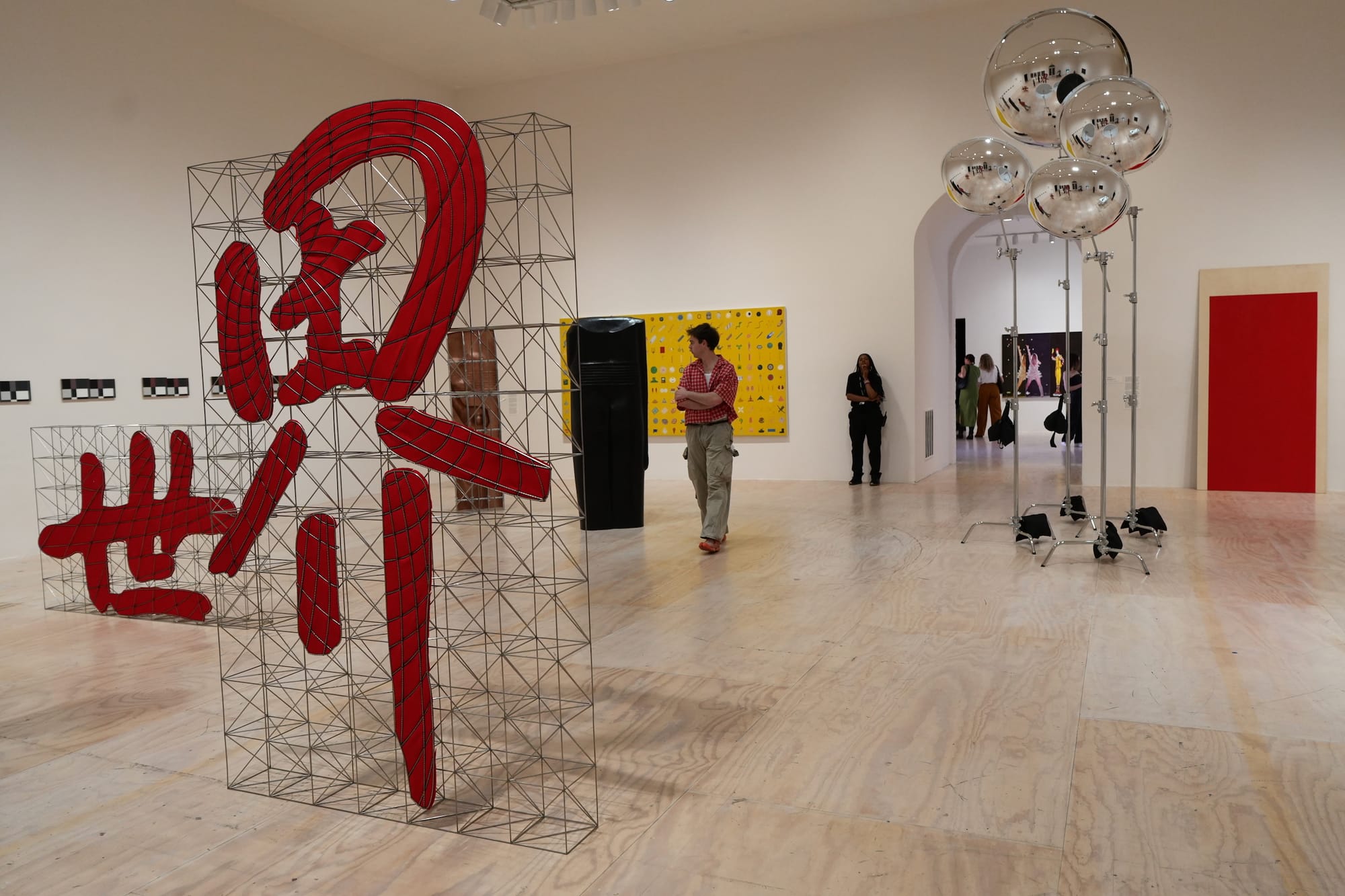
Every five years, MoMA PS1 attempts to capture the shifting tectonic plates of the New York art world. The latest iteration of Greater New York, the museum's signature quinquennial survey, arrives at a symbolic crossroads, marking the institution's 50th anniversary. Featuring more than 50 artists in the formative stages of their careers, the survey functions as a collective psychological profile of a city navigating a period of deep structural anxiety — about housing, about displacement, about who gets to call New York home.
The curatorial approach for this edition purposefully bypasses the New York of the consumer — the city of high-gloss surfaces and sterilized commercial districts. Instead, the exhibition embraces a raw, unvarnished aesthetic that mirrors the city's actual street-level reality. It is an acknowledgment that the "real" New York is often found in the friction of its formation, rejecting the ease of the brand for the difficulty of the grit.
A Survey Built on Emergence, Not Establishment
The Greater New York format has always carried a particular curatorial wager: that a snapshot of emerging practice can reveal something about the city that established names cannot. The first edition, mounted in 2000, arrived during a period of late-boom optimism and helped launch careers that would go on to define the decade's gallery circuit. Subsequent iterations tracked the aftermath of September 11, the financial crisis, and the broader reconfiguration of the city's cultural geography as gentrification pushed artist communities further from Manhattan's core.
This sixth edition inherits that lineage but operates under different pressures. The New York art ecosystem of the mid-2020s is shaped by forces that were peripheral a decade ago: the consolidation of mega-galleries, the migration of studio space to boroughs and suburbs once considered peripheral, and a generation of artists who came of age during overlapping crises — pandemic, political polarization, economic precarity. By focusing on artists whose trajectories are still being mapped, the exhibition mirrors the city's own unfinished narrative. The choice to foreground emergence rather than accomplishment is itself a statement: that the most honest portrait of New York is one drawn in provisional lines.
PS1's Long Island City campus, a converted public school building, has always lent the survey a physical texture distinct from the white-cube neutrality of its parent institution across the river. The industrial architecture resists polish. Work installed in former classrooms and stairwells carries a spatial charge that reinforces the exhibition's thematic commitment to roughness over refinement. The building becomes a participant in the argument.
Grit as Method, Not Nostalgia
There is a risk, in any exhibition that foregrounds urban grit, of lapsing into nostalgia for a mythologized "old New York" — the loft-era downtown of the 1970s and 1980s that has become its own kind of brand. What distinguishes this edition of Greater New York is its apparent refusal of that backward glance. The grit on display is not a citation of the past but a description of the present: a city where creative life persists not because of favorable conditions but in spite of unfavorable ones.
That distinction matters. New York's identity as a cultural capital has long rested on a narrative of productive friction — the idea that density, diversity, and difficulty generate art that comfort cannot. Whether that narrative still holds, or whether it has become a convenient story the city tells itself while its material conditions for artists erode, is a tension the exhibition does not resolve. It may not need to. The work of 50 emerging practitioners, taken together, constitutes evidence rather than argument. Viewers are left to weigh the vitality on the walls against the structural forces pressing in from outside them.
The exhibition presents a New York that is simultaneously striking and lacerating, a place defined more by its constant state of becoming than by its finished monuments. In this snapshot, the city remains a site of cautious hope — but hope held in tension with the recognition that the conditions sustaining creative life are not guaranteed. Whether the artists in this survey will still be working in New York by the time the next quinquennial arrives is itself an open question, and perhaps the most revealing one the exhibition poses.
With reporting from Hyperallergic.
Source · Hyperallergic