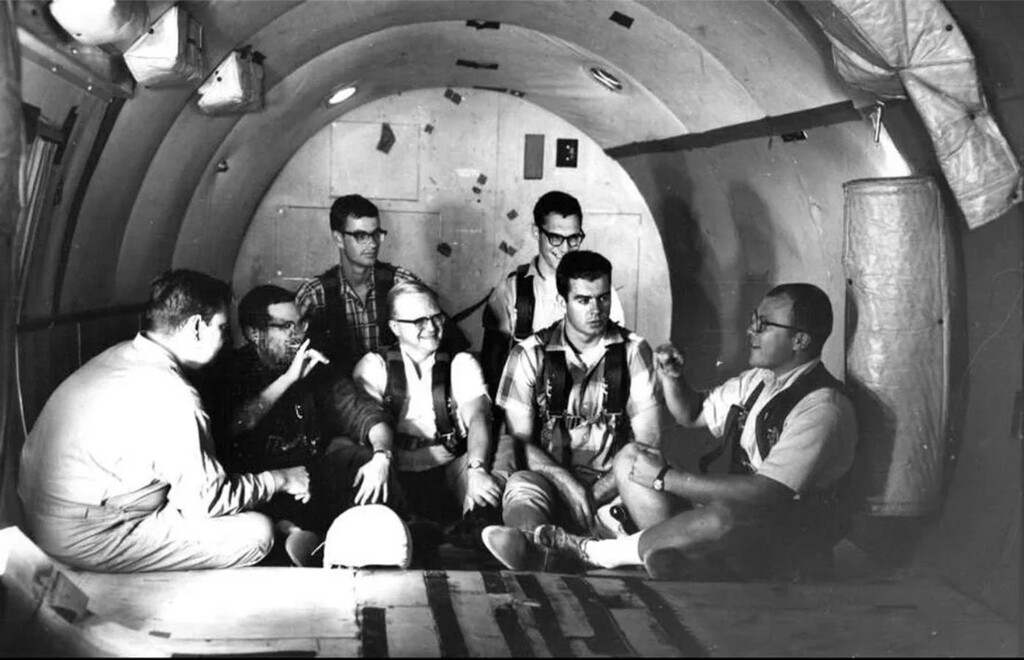
In the late 1950s, as NASA prepared to launch the first humans into orbit, the agency faced a biological hurdle as daunting as the physics of propulsion: motion sickness. Known scientifically as kinetosis, the condition is a product of sensory contradiction. When the eyes perceive motion that the inner ear’s vestibular system cannot confirm—or vice versa—the brain reacts with nausea. To understand this mechanism, researchers needed a baseline of human subjects who were physiologically incapable of feeling the spin.
They found their answer at Gallaudet College, now Gallaudet University, where they recruited 11 men between the ages of 25 and 48. Most of the group had lost their hearing early in life to spinal meningitis, a disease that had also permanently damaged their vestibular systems. This impairment granted them a rare form of immunity. While the fluid in a typical person’s inner ear would churn during the rigors of flight, the Gallaudet 11 remained perfectly stable.
The resulting experiments were often a study in contrasts. During high-intensity testing designed to induce vomiting, the researchers themselves frequently succumbed to the physical strain. Meanwhile, the Gallaudet men were reportedly found passing the time by playing cards, entirely unaffected by the turbulence. Their contribution provided the definitive evidence NASA needed to confirm the inner ear as the primary culprit of space sickness, allowing the agency to develop the protocols and medications that would eventually sustain the Apollo missions.
With reporting from Xataka.
Source · Xataka