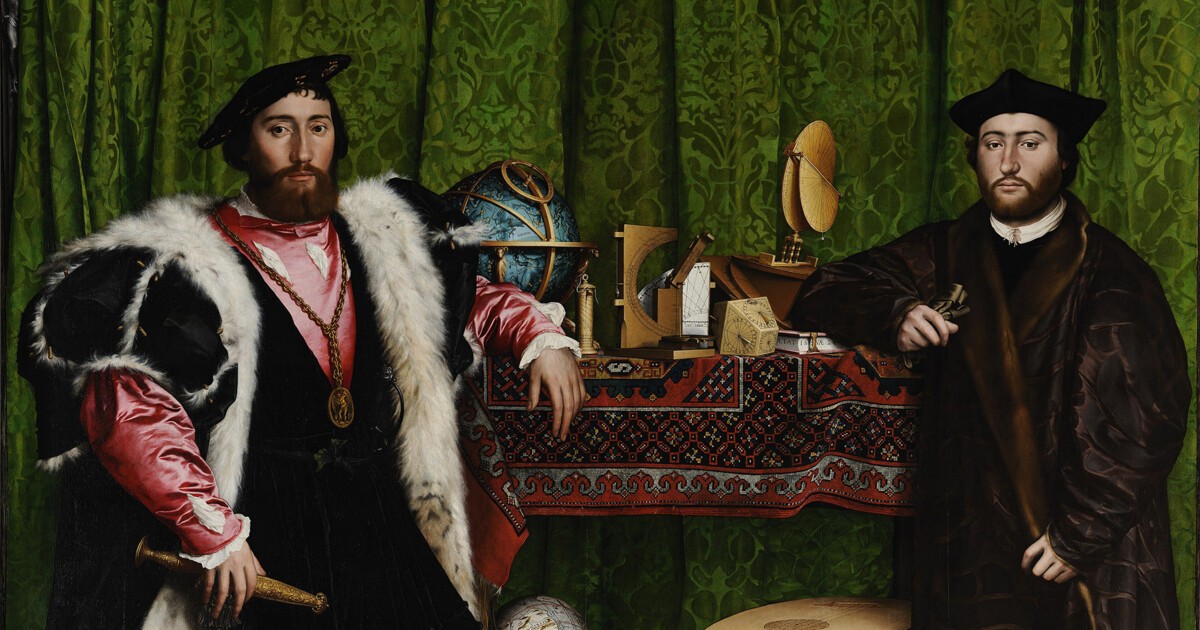
Hans Holbein the Younger's The Ambassadors, completed in 1533, hangs in the National Gallery in London as one of the most scrutinized paintings of the Northern Renaissance. The double portrait depicts two French diplomats — Jean de Dinteville and Georges de Selve — standing on either side of a two-tiered shelf laden with objects: celestial and terrestrial globes, sundials, a lute with a broken string, a set of flutes, a hymnal, and various instruments of navigation and measurement. The painting is large, roughly life-sized, and its surface is dense with symbolic detail that has generated centuries of scholarly debate.
The work arrived at the National Gallery in 1890 and has since become one of the institution's most discussed holdings, not for the beauty of its composition alone but for the interpretive puzzles it poses. Chief among these is the elongated, distorted shape that stretches diagonally across the lower portion of the canvas — an anamorphic skull, visible in its correct proportions only when the viewer approaches the painting from a sharp angle to the right. It is a technical feat and a philosophical provocation in equal measure.
The fracture lines of 1533
The year Holbein painted The Ambassadors was one of acute religious and political rupture in Europe. Henry VIII had broken with Rome, the Lutheran Reformation was reshaping the spiritual geography of the German-speaking lands, and the unity of Western Christendom — already strained by decades of theological dispute — was splintering into rival confessions. Dinteville was in London on a diplomatic mission for Francis I of France; de Selve, a bishop, had been involved in efforts to mediate between Catholic and Protestant factions.
The objects on the shelf between them can be read as a catalogue of these tensions. The lute with its broken string has long been interpreted as a symbol of discord — political, religious, or both. The hymnal, open to pages associated with Lutheran worship, sits alongside instruments of empirical science, suggesting a world in which old certainties of faith were being challenged by new modes of knowledge. The painting does not resolve these tensions. It holds them in suspension, presenting the viewer with a tableau of competing authorities — ecclesiastical, diplomatic, scientific — without declaring a winner.
This refusal to resolve is part of what makes the work endure as an object of interpretation. Unlike allegorical paintings that point toward a clear moral, The Ambassadors operates more like a cipher: legible in parts, opaque as a whole.
Friendship, mortality, and the limits of representation
Beyond its engagement with the political crises of its moment, the painting also participates in a long tradition of representing friendship. The classical concept of amicitia — friendship as a bond between equals who serve as mirrors to one another — runs through Renaissance humanism. Dinteville and de Selve are presented as learned, worldly, composed. Their posture and dress suggest confidence, status, and intellectual refinement.
Yet the anamorphic skull disrupts this confident surface. It is a memento mori — a reminder of death — rendered in a form that is literally invisible from the painting's conventional viewing angle. The viewer must shift position, abandon the frontal gaze, to see it clearly. The implication is unsettling: the fact of mortality is always present but requires a change in perspective to be recognized. No accumulation of knowledge, no diplomatic skill, no depth of companionship exempts its subjects from that fact.
Holbein's technical mastery here serves a philosophical function. The anamorphosis is not merely a display of virtuosity; it is an argument about the limits of representation itself. A single vantage point cannot capture the full meaning of the image. The painting insists that seeing is partial, that understanding depends on where one stands.
Five centuries after its creation, The Ambassadors continues to resist a settled reading. It sits at the intersection of art history, religious history, the history of science, and the philosophy of perception — a work that rewards attention without ever fully yielding its meaning. Whether it is best understood as a document of Reformation-era anxiety, a meditation on the classical ideal of friendship, or an exercise in the instability of visual knowledge may depend less on the painting than on the interpreter. The skull, after all, is always there. The question is whether the viewer chooses to look.
With reporting from London Review of Books.
Source · London Review of Books