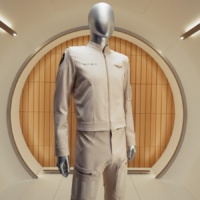
As the commercial race to populate low-Earth orbit accelerates, attention is migrating from the heavy engineering of launch vehicles to a less dramatic but equally consequential domain: the daily ergonomics of living and working in space. Vast, the California-based startup developing the Haven-1 station, recently unveiled its inaugural flight suit — a modular ensemble designed for the specific demands of private astronaut missions. The suit eschews the bulky, one-piece jumpsuits that defined crewed spaceflight for decades, favoring instead a utilitarian architecture that draws from high-end industrial and technical apparel design.
The garment system is built around flexibility. Astronauts can wear the jacket and cargo pants as separates during routine labor or zip them together into a conventional flight jumpsuit for formal operations. Each suit is custom-tailored to the individual wearer, with strategically placed pockets and Velcro fasteners engineered to prevent tools and personal items from drifting in microgravity. Vast CEO Max Haot has described the design as an iterative first version — a bespoke baseline intended to evolve as the company progresses through missions to the International Space Station and, eventually, operations aboard its own orbital outpost.
From survival gear to workwear
For most of the history of human spaceflight, what astronauts wore inside a spacecraft was an afterthought subordinated to the pressurized suits required for launch and reentry. The intravehicular garments used aboard the Space Shuttle and the ISS were largely functional coveralls — adequate, but not designed with the kind of ergonomic intentionality that defines modern technical clothing. The shift Vast is signaling is subtle but meaningful: treating the flight suit not as a uniform handed down by an agency, but as a purpose-built tool shaped by the specific workflow of its wearer.
This mirrors a broader pattern in industries that mature past their pioneering phase. Early offshore oil workers, deep-sea divers, and Antarctic researchers all went through analogous transitions, moving from improvised or military-surplus gear to specialized apparel engineered for the particular hazards and tasks of their environment. That Vast is investing in custom tailoring and modular construction at this stage suggests the company views crew comfort and operational efficiency as competitive differentiators, not luxuries.
The semiotics of professionalization
The design also reflects a dual necessity in the emerging private space sector: rugged functionality on one hand, and a credible public image on the other. Megan McArthur, a former NASA astronaut and advisor to Vast, noted that while the base layers — a tech t-shirt and cargo pants — provide the mobility needed for station life, the addition of the jacket enables a transition to a more polished aesthetic for hatch openings, media broadcasts, or client-facing moments. It is, in effect, a dress code for a new class of orbital worker, operating in an environment where the boundary between laboratory and corporate office grows thinner with each mission.
This is not merely cosmetic. As commercial stations begin hosting paying customers, government-sponsored researchers, and corporate tenants, the visual language of professionalism becomes a tool of legitimacy. NASA's own branding — the iconic blue suits, the mission patches — served a similar function for decades, translating the abstraction of spaceflight into something legible and trustworthy to the public and to Congress. Private operators now face the same challenge with a different audience: investors, commercial partners, and a skeptical market that still associates space habitation with government monopoly.
The deeper question the Vast suit raises is whether the commercial space station sector is approaching the threshold where operational details — crew workflow, onboard logistics, habitability — begin to matter as much as launch cadence and payload capacity. Rocket companies have dominated the narrative of the new space economy for over a decade. But as destinations in orbit multiply and mission durations extend, the companies that design the most livable, most functional environments may hold an advantage that no launch provider can replicate. Whether Vast's modular suit is a genuine step in that direction or a well-timed piece of branding remains a distinction the market will render only after Haven-1 is occupied and operating.
With reporting from Payload Space.
Source · Payload Space