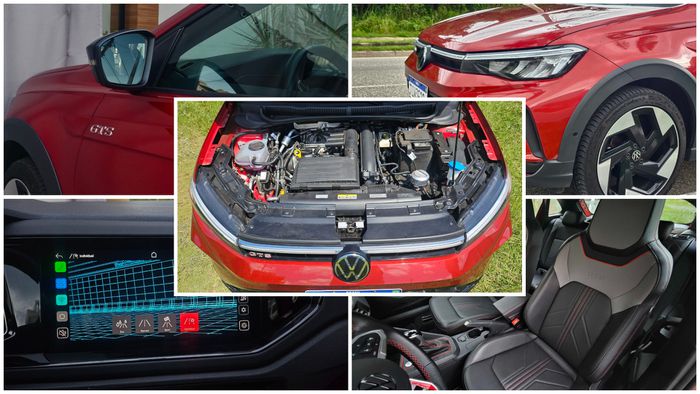
The Brazilian automotive market has witnessed the consolidation of the Nivus line with the introduction of the GTS variant, positioned as the new pinnacle of Volkswagen's portfolio. This development reconfigures the Highline variant to an upper-mid-tier position, prompting an inevitable inquiry among enthusiasts and prospective buyers: what, precisely, justifies the additional investment of approximately R$20,000 to bear the performance designation?
The fundamental answer resides beneath the hood. While conventional variants rely on the efficient 200 TSI engine, the Nivus GTS incorporates the 250 TSI powertrain. This is the 1.4-liter Turbo Flex engine, producing 150 hp, identical to the unit found in the mid-size Taos SUV. This mechanical transition alters the vehicle's dynamics, imbuing it with a responsiveness and acceleration profile that distinguishes it from the purely urban orientation of the entry-level variants.
In practical terms, this augmented power translates to a 0 to 100 km/h acceleration time of 8.4 seconds—a mark considerably superior to that of the Highline. Beyond mere specifications, this alteration reflects the German automaker's strategy to deliver a more engaging driving experience, endeavoring to balance the versatility of a compact SUV with the historical performance ethos of the GTS lineage.
Source: Canaltech.
Source · Canaltech