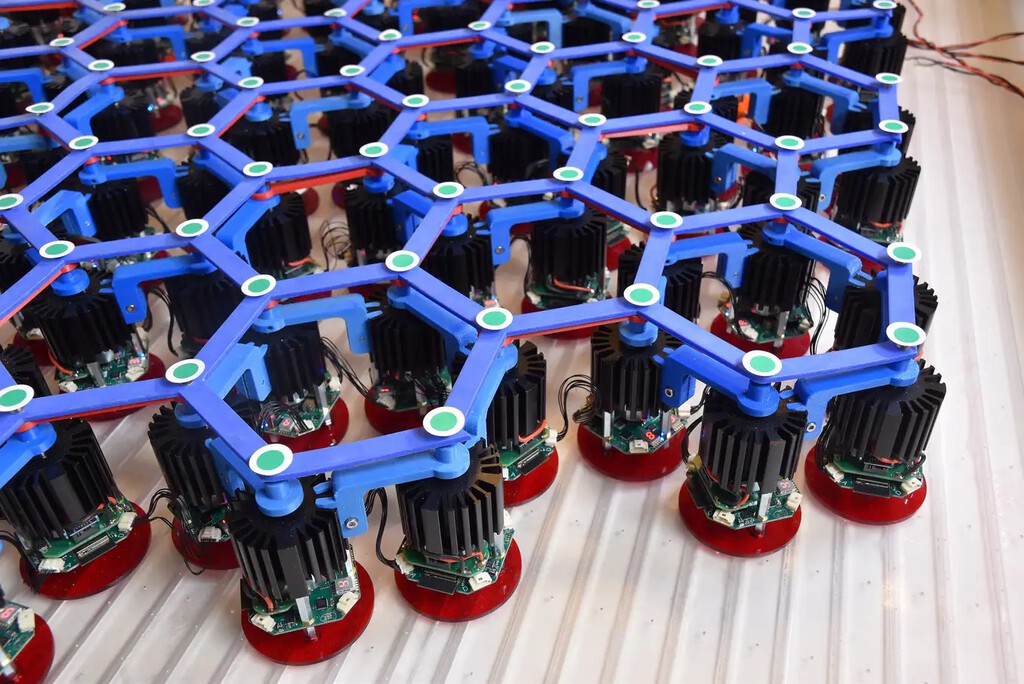
The boundary between the inanimate and the biological has just become a little more tenuous. Researchers at the University of Amsterdam have published a study in the journal *Nature* on metamaterials — structures engineered to possess properties not found in nature — capable of "learning" and autonomously adapting their shape. Unlike conventional robots, these materials do not rely on a centralized brain to dictate every movement.\n\nThe structure resembles a robotic worm, composed of segments joined by motorized hinges. Each module possesses its own microcontroller and sensors that record past rotations and movements, creating a form of local memory. By exchanging information with neighboring hinges, the material adjusts its collective rigidity and position, allowing the system as a whole to evolve into more efficient forms of locomotion or support.\n\nThe significant breakthrough of this research lies in the decentralization of intelligence. Instead of complex software processing data externally, the learning capability is embedded within the material's own architecture. Through impulses sent by researchers during the training phase, the segments learn to coordinate forces to achieve specific postures, mimicking the behavior of simple living systems.\n\nThis innovation paves the way for a new generation of infrastructures and devices that can self-repair or adapt to hostile environments without human intervention. By transforming physics into a rudimentary form of cognition, science begins to treat inanimate objects not merely as static tools, but as agents capable of functional evolution.\n\nWith information from Xataka.
Source · Xataka