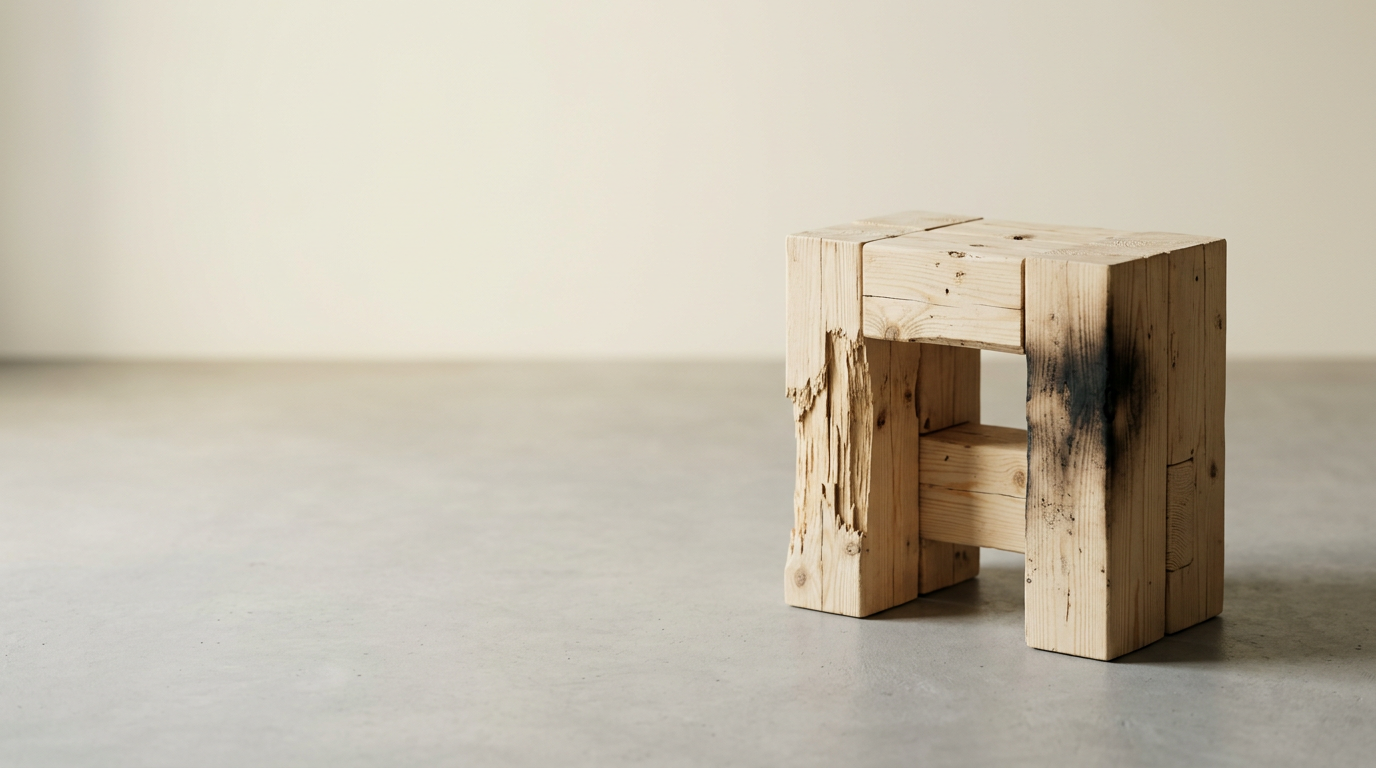
At the most recent Milan Design Week, Helsinki-based designer Didi Ng Wing Yin introduced a collection that challenged the conventional aesthetics of high-end furniture. Titled "In Between Wood and Fire," the series of five bespoke pieces—including coffee tables, side tables, lamps, and stools—was showcased at the prestigious Spazio Rossana Orlandi. Rather than utilizing fine hardwoods or veneers typical of luxury design, Ng opted for standard, 10-by-10-centimetre construction-grade spruce and pine, materials usually relegated to structural framing or temporary scaffolding.
According to Dezeen reporting, the collection serves as a deliberate departure from the designer’s previous focus on technical finesse. By splitting, carving, and charring these utilitarian hunks of wood, Ng transformed discarded-looking lumber into expressive, sculptural objects. This editorial analysis explores how this shift toward "humorous" materiality reflects a broader, maturing trend in contemporary craft, where designers are increasingly interrogating the inherent limitations of their medium rather than attempting to suppress them.
The Technical Subversion of Materiality
In the world of fine woodworking, construction lumber is often viewed with skepticism due to its inherent instability. Because these pieces are typically kiln-dried at speed and intended for hidden structural support, they are prone to warping, twisting, and cracking when exposed to the changing humidity of domestic interiors. Ng’s approach, however, leans into these imperfections. By using a combination of axes, chisels, and froes to split the wood, he argues that the material behaves more predictably when allowed to fracture along its natural grain rather than being forced into rigid, standardized shapes.
This is not merely a stylistic choice but a fundamental reassessment of what constitutes "quality" in design. Historically, the pursuit of perfection in furniture design has been synonymous with the elimination of knots, checks, and grain irregularities. Ng’s work, conversely, celebrates these features by highlighting the fractured qualities of the timber. By charring the wood with a blowtorch and applying ink to emphasize the deep, irregular textures, he creates a visual language that feels both primal and intentional. This process transforms a commodity product into a unique artifact, effectively bridging the gap between the rough-hewn aesthetic of traditional Finnish timber work and the refined expectations of the Milanese design circuit.
The Rise of Humorous Functionality
Perhaps the most striking element of Ng’s collection is the injection of what he terms a "humorous approach." In furniture design, humor is a rare and often risky commodity. It is frequently conflated with novelty or kitsch, yet in Ng’s hands, it functions as a tool for de-escalating the solemnity of contemporary design. The incorporation of bowl-shaped indents into the surface of a coffee table, ostensibly for fruit, acts as a playful subversion of the "coffee table" archetype. It is a functional gesture that borders on the cartoonish, yet it is executed with the gravitas of a serious craft practice.
This dynamic is further reinforced by the flame-shaped feet on the Rocket coffee table. These features serve as a narrative anchor, referencing the designer's ongoing fascination with firewood splitting—a common domestic ritual in Finland. By turning the practical necessity of heat production into a design motif, Ng creates a dialogue between the origin of the material and its final form. This is a departure from the "form follows function" mantra that has dominated the industry for decades. Instead, Ng proposes a model where form follows the narrative of the material, allowing the wood to dictate the degree of playfulness allowed in the final composition.
Implications for Sustainable Craft and Industry
For the broader design industry, Ng’s work raises significant questions about the future of material consumption. As the cost of premium hardwoods rises and the environmental impact of long-distance timber sourcing becomes increasingly scrutinized, the ability to derive high-value objects from low-grade, readily available construction timber represents a compelling shift. It suggests that the value of a piece of furniture may lie less in the scarcity of its components and more in the labor-intensive, specialized transformation of common materials. This is a model that could, in theory, be scaled to support more localized, circular design economies.
However, this approach also creates tension with traditional manufacturing standards. Regulatory bodies and mass-market retailers often prioritize consistency and safety, qualities that are antithetical to the "fractured" and "unstable" nature of Ng’s work. As designers continue to push for more experimental uses of raw materials, the divide between the artisan-led gallery world and the industrial furniture sector is likely to widen. The challenge for future practitioners will be to reconcile this newfound freedom of expression with the practical, safety-oriented requirements of the mass market, particularly when dealing with materials that are fundamentally prone to movement.
The Outlook for Material-First Design
As Didi Ng Wing Yin’s practice evolves, the question remains whether this "material-first" philosophy will translate into broader commercial viability. While his work has been lauded in high-end exhibition spaces like Milan, the transition from bespoke, one-off pieces to a sustainable studio practice is notoriously difficult. The reliance on manual, labor-intensive techniques like hand-carving and torch-charring limits the potential for scale, keeping such work firmly within the realm of the collectible design market for the foreseeable future.
Furthermore, the long-term durability of such aggressively treated construction wood remains an open question. While the designer has effectively stabilized the material through his specific splitting techniques, the behavior of these pieces over decades of use in diverse climates will be the ultimate test of his methodology. As observers of the design scene continue to track the evolution of "In Between Wood and Fire," the focus will likely shift toward how these techniques can be adapted for more functional, everyday use cases without losing their distinct character. The dialogue between the raw, the charred, and the humorous is only just beginning.
With reporting from Dezeen
Source · Dezeen