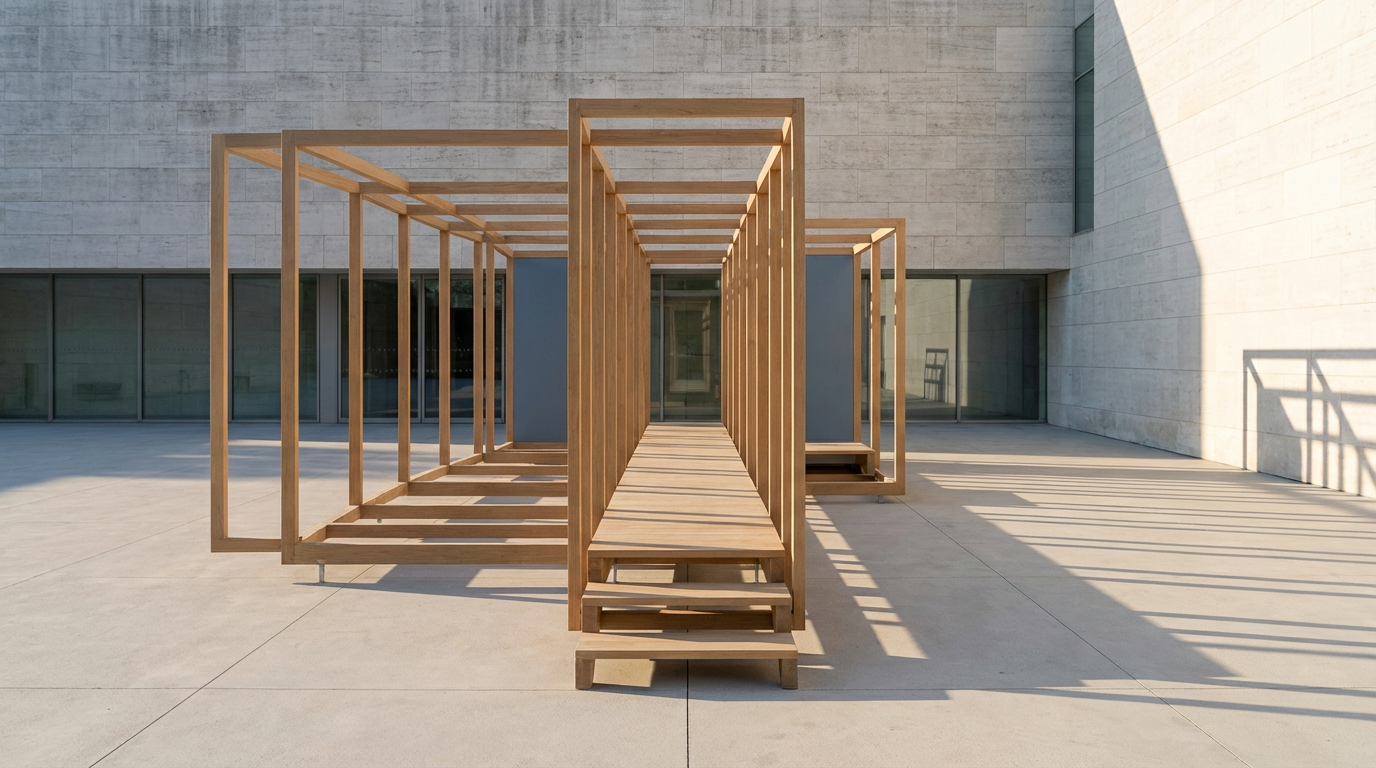
A mobile voting booth, designed by architecture students at the Frankfurt University of Applied Sciences, currently stands outside the Museum of Applied Arts in Frankfurt. As part of the World Design Capital 2026 initiative, the structure serves as a full-scale architectural installation that transforms the abstract, often invisible process of democratic participation into a tangible, spatial experience. Unlike the static, enclosed booths typically found in government buildings, this installation invites users to climb, enter, and navigate a series of platforms and thresholds.
According to reporting from Designboom, the project functions as a prototype for civic infrastructure, emphasizing modularity and accessibility. By positioning the act of voting as a physical alignment within the surrounding museum complex, the design team suggests that the architecture of participation is not merely a bureaucratic necessity, but a deliberate choice about how individuals occupy and relate to their civic environment. The booth acts as a spatial critique of the isolation inherent in traditional voting mechanisms, proposing instead a model that is visible, climbable, and inherently public.
The Architecture of Civic Legibility
The central premise of the Frankfurt project lies in making the mechanics of participation legible. In contemporary urban design, civic spaces are frequently treated as neutral containers for state-sanctioned activities. By contrast, the timber-framed booth utilizes a lightweight, modular skeleton where every bolted joint is intentionally visible. This structural honesty serves a dual purpose: it demystifies the construction process and underscores the portability of the system. By using standardized, reusable elements, the architects move away from the permanence of monumental civic architecture toward a more fluid, adaptive model of infrastructure.
This legibility extends to the user experience. The booth is not a singular, prescriptive box but a sequence of exposures and concealments created by alternating corrugated metal and translucent plastic panels. This spatial layering forces the participant to navigate a series of choices—where to stand, how far to ascend, and which vistas to observe. In doing so, the architecture mirrors the complexity of the democratic process itself, where the act of taking a position is informed by the physical and social vantage point of the participant. The booth becomes a stage where the user is both the performer and the observer of their own civic engagement.
Mechanisms of Participation and Spatial Agency
The mechanism of the booth relies on the interplay between verticality and perspective. As users ascend the platforms, their relationship to the surrounding museum complex shifts, reframing the act of voting from an isolated, private duty into a public, situated event. This vertical progression is crucial; it disrupts the traditional 'curtain-drawn' model of voting, which historically emphasizes privacy to the point of social erasure. By elevating the voter, the booth provides a literal and metaphorical shift in perspective, allowing for a broader view of the civic landscape.
Furthermore, the modular nature of the timber frame allows for rapid deployment and reconfiguration in diverse urban contexts. This flexibility is a direct response to the limitations of current civic infrastructure, which is often rigid, centralized, and disconnected from the daily flow of urban life. By creating a structure that can be disassembled, transported, and rebuilt, the students offer a blueprint for decentralized civic engagement. This is not merely about aesthetic design; it is a functional prototype that challenges the necessity of permanent, static architecture for the maintenance of democratic processes. The incentives here are clear: by lowering the barrier to entry and integrating the booth into the fabric of the city, the architects aim to make the act of participation as accessible as the public realm itself.
Implications for Urban Governance and Design
The implications of this approach extend beyond the immediate context of the World Design Capital. For regulators and city planners, the project raises significant questions regarding the intersection of security and accessibility in public spaces. Traditional voting booths are often governed by strict regulations prioritizing anonymity and tamper-proof environments. A mobile, modular, and partially open structure challenges these norms, forcing a conversation about whether the current standards for 'secure' voting environments inadvertently discourage participation by alienating the voter from the city.
For competitors and architects, the project suggests a shift toward 'civic prototyping'—a design strategy where public infrastructure is tested through temporary, iterative installations rather than fixed, long-term construction projects. This allows for real-time feedback from the public, enabling designers to refine the ergonomics of participation based on how citizens interact with the structure. The tension between the need for a controlled, private voting environment and the desire for a public, visible civic presence remains a central challenge for urban designers tasked with future-proofing democratic spaces.
Outlook: The Future of Civic Infrastructure
What remains uncertain is whether such prototypes can be scaled or integrated into formal state election processes without compromising the rigorous security standards required for national ballots. While the Frankfurt installation succeeds as a conceptual and architectural intervention, the transition from a design prototype to a functional, legally recognized voting station involves complex regulatory hurdles. The project effectively highlights the current gap between the rigid, bureaucratic requirements of voting and the fluid, evolving nature of modern urban life.
As cities continue to grapple with declining public engagement and the erosion of communal spaces, the question of how architecture can facilitate democratic participation remains open. The success of this installation will likely be measured not by its ability to replace existing systems, but by its capacity to provoke a broader dialogue among urban planners and policymakers about the necessity of rethinking the physical spaces of democracy.
As the integration of modular, citizen-centric design into civic infrastructure continues to evolve, the tension between traditional security requirements and the need for accessible, public-facing participation will likely define the next generation of urban design. Whether this approach leads to a new standard in electoral architecture or remains a unique pedagogical exercise, it serves as a necessary reminder that democracy requires not just laws, but a physical home within the city.
With reporting from Designboom
Source · Designboom