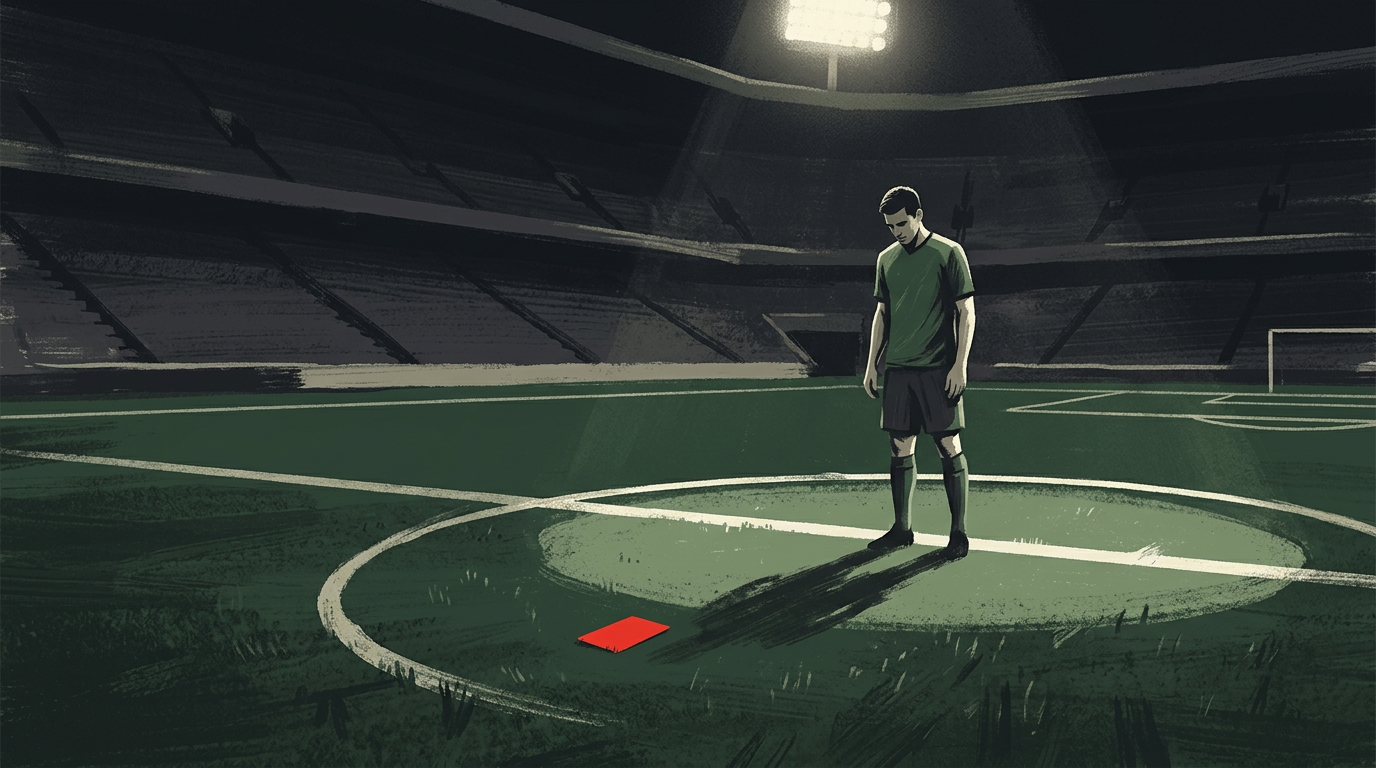
The landscape of global football is undergoing a structural transformation as FIFA and the International Football Association Board (IFAB) have officially approved a regulation authorizing match officials to issue immediate red cards to players who cover their mouths during on-pitch confrontations. For decades, athletes have reflexively shielded their faces with hands or jerseys to prevent broadcast cameras and lip-readers from deciphering their words. Under this new mandate, that ingrained habit is no longer a tactical privacy measure but a direct disciplinary offense.
According to reporting from Hypebeast, the regulatory update targets the toxic elements of on-pitch discourse by establishing a strict presumption of guilt for those who intentionally obscure their speech during arguments. By stripping players of the ability to hide their dialogue, governing bodies are signaling that the era of private, unmonitored communication on the pitch has effectively ended. This development represents a significant expansion of institutional oversight, where the act of concealment itself is now treated as an admission of malice.
The Philosophy of Surveillance in Sport
At the heart of this regulatory shift lies a fundamental tension between the traditional autonomy of the game and the modern demand for total visibility. Historically, football has functioned as an enclosed space where heated exchanges were considered part of the competitive friction. While discriminatory abuse has long been a blight on the sport, the decision to criminalize the act of covering one’s mouth reflects a shift toward a panoptic model of governance. By mandating that players remain visible at all times, FIFA is essentially asserting that there should be no "off-the-record" moments in professional football.
This movement mirrors broader societal trends where institutional trust has been replaced by technological and procedural surveillance. The reliance on cameras, VAR, and now the policing of physical gestures suggests that governing bodies no longer trust the internal culture of the game to self-regulate. Instead, the focus has shifted to removing the possibility of concealment entirely. This philosophy of "transparency at any cost" assumes that if an athlete is not hiding anything, they have no reason to cover their mouth, thereby equating the gesture with an inherent intent to commit a violation. It is a procedural shortcut that prioritizes administrative ease over the nuance of human interaction.
The Mechanism of Presumed Guilt
From a mechanical perspective, the new rule fundamentally alters the power dynamics between players and officials. By granting referees absolute discretion to issue a red card based on the act of covering one’s mouth, the rule creates a high-stakes scenario where an athlete’s physical movement is judged independently of the content of their speech. This creates a dangerous precedent: the punishment is triggered by the method of communication rather than the substance of the words themselves. The logic is that the gesture is a proxy for guilt, effectively shifting the burden of proof onto the player.
This mechanism forces players to navigate a new, rigid set of behavioral constraints. In the heat of a high-pressure match, where adrenaline and emotional volatility are at their peak, athletes are now tasked with maintaining a specific standard of visual conduct. The incentive structure is clear: any lapse in composure that leads to a defensive gesture will result in immediate expulsion. This level of behavioral policing is unprecedented in professional sports, potentially changing the way players interact with one another. The fear of an automatic red card may suppress not only abusive language but also the intense, competitive dialogue that has long been a staple of the sport’s emotional intensity.
Implications for Stakeholders
For referees, this mandate introduces a new layer of complexity. While it aims to simplify the detection of abuse, it places an immense burden of judgment on the official. Referees must now distinguish between a player covering their mouth to adjust a mouthpiece or catch their breath and one doing so to hide an insult. This ambiguity could lead to inconsistent application of the rules, sparking debates about bias and over-officiating. For the players, the implications are even more direct. The regulation effectively removes a layer of personal privacy, forcing them to perform under a constant, critical gaze that extends far beyond the ball.
Regulators, meanwhile, are betting that this visibility will act as a sufficient deterrent against discriminatory behavior. However, there is a risk that such rigid rules will simply drive toxic behavior into more subtle, less visible forms. If the goal is to sanitize the game, the unintended consequence may be a more performative, less authentic environment where players are hyper-aware of the "camera-ready" nature of their conduct. The tension between the desire for a clean, professional product and the reality of an intensely competitive, emotional sport remains unresolved.
The Outlook for On-Pitch Governance
What remains uncertain is how this rule will be applied in the high-stakes environment of international tournaments. The variability in how different officials interpret the "intent" behind a covered mouth could lead to controversy, particularly if a red card is issued during a pivotal moment of a match. The question of whether this rule will truly decrease abuse or merely create new avenues for referee-led controversy is a subject that will likely dominate the discourse in the coming seasons.
Furthermore, the long-term impact on the culture of the game warrants close observation. As the sport continues to integrate more layers of surveillance and behavioral regulation, the line between professional conduct and total institutional control will continue to blur. Whether this leads to a more respectful game or simply a more controlled, sanitized version of the sport is a question that will be answered only through the practical application of these new powers on the field.
As these regulations are integrated into the fabric of the sport, the question of whether total transparency is a viable substitute for cultural change remains open. The evolution of football’s disciplinary framework suggests that the institution is willing to sacrifice privacy for the sake of order, yet the efficacy of such a top-down approach remains to be seen in the heat of competition.
With reporting from Hypebeast
Source · Hypebeast