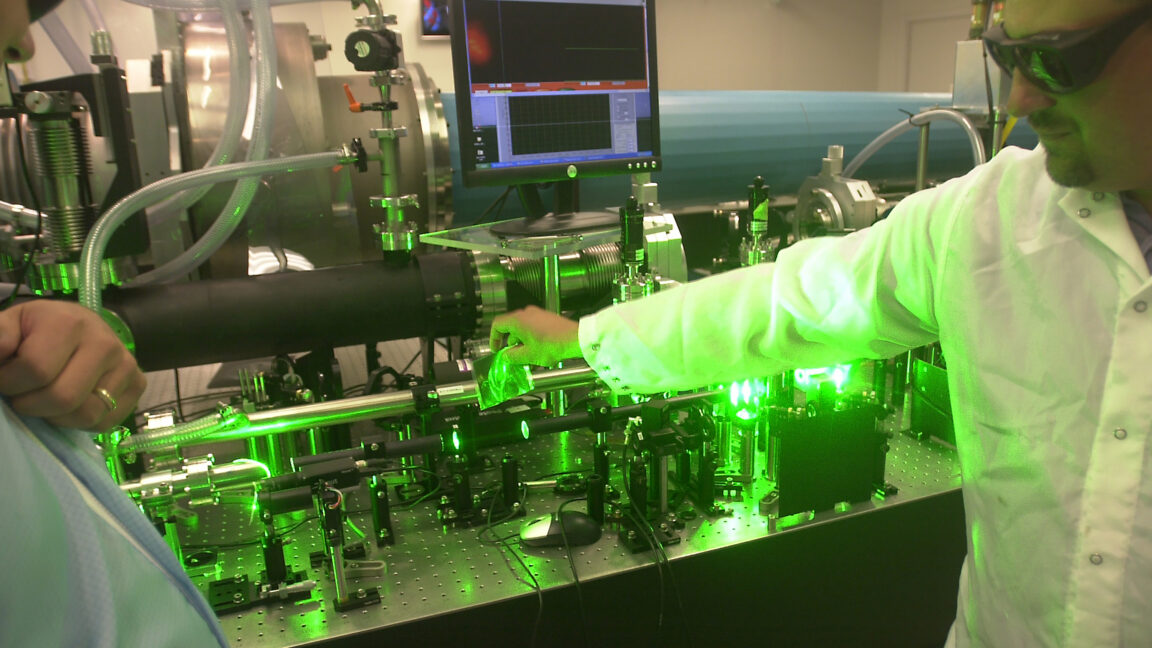
Hidden beneath the lawn of the University of Texas at Austin, two stories below the student routine, lies a dormant giant of modern physics. The Texas Petawatt (TPW) was not merely a piece of laboratory equipment, but one of the most potent tools in the American scientific arsenal, capable of generating light pulses with a power that, for an infinitesimal instant, surpassed the entire electrical grid of the United States.
The operation of a single shot was an exercise in extreme precision. To prevent the pure energy from destroying its own optical components, the laser employed a temporal manipulation technique: the light pulse was stretched, massively amplified, and finally compressed back to a trillionth of a second. The result was the creation of a "star" in miniature within a vacuum chamber, enabling the study of extreme states of matter and astrophysical phenomena on a controlled scale.
Despite its strategic relevance as part of LaserNetUS, a network of the U.S. Department of Energy, the TPW's brilliance was overshadowed by budgetary concerns. Recently decommissioned due to funding cuts, the laboratory leaves a void in the nation's high-power research infrastructure. Its closure marks the end of an era for the scientists who, between 2020 and 2024, operated this final frontier of experimental physics.
With information from Ars Technica.
Source · Ars Technica