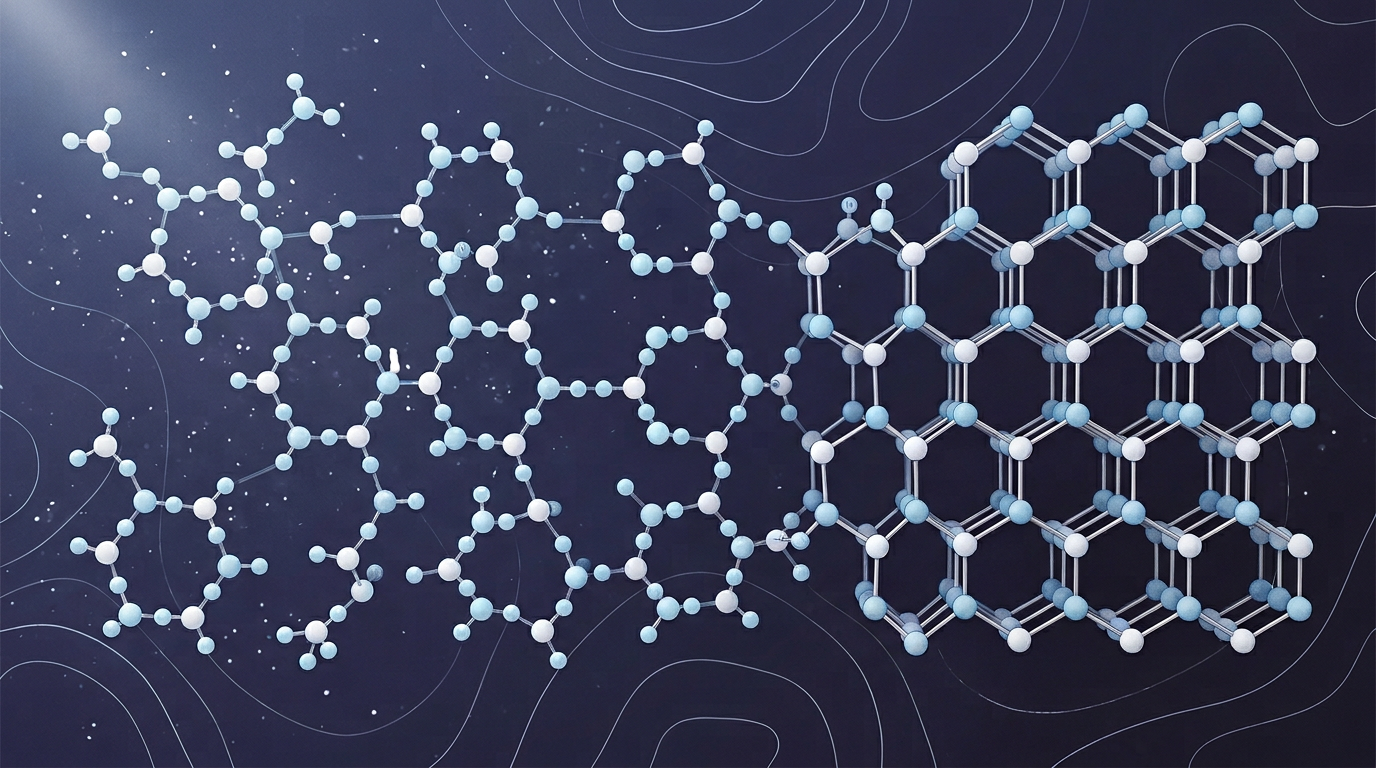
The study of ice has long transcended the simple observation of frozen water in a domestic freezer or a mountain glacier. Recent scientific investigations have confirmed the existence of increasingly complex crystalline phases of water, pushing the total count of identified ice forms to more than 20 since the early 20th century. According to reporting from Quanta Magazine, these discoveries are not merely academic curiosities; they represent a fundamental expansion of our understanding of how H2O behaves under extreme pressure and temperature regimes.
This ongoing research into ice phases, which includes exotic states like "hot ice" and electrically conductive ice, suggests that water is far more versatile in its solid form than classical chemistry initially proposed. By analyzing these structures, physicists are uncovering the hidden rules governing molecular arrangement. The editorial thesis here is that the discovery of these complex ice phases acts as a proxy for the broader frontier of material science, where the ability to manipulate molecular geometry under extreme conditions is becoming a cornerstone of future technological innovation.
The Architecture of Molecular Complexity
To understand why these new phases are significant, one must first appreciate the definition of ice within the context of condensed matter physics. Ice is formally categorized as any phase of water that maintains a solid, crystalline state—meaning its constituent molecules are arranged in a repeating, predictable pattern. However, the sheer variety of these patterns is what continues to surprise researchers. Under varying pressures, the hydrogen bonds that hold water molecules together can shift, fold, and reorient, leading to entirely new physical properties that deviate significantly from standard ice.
Historically, the study of ice was limited by the technological inability to replicate the crushing pressures found deep within planetary interiors or within the cores of icy moons. As simulation capabilities have improved, physicists have gained the ability to predict where these new phases might exist before they are experimentally observed. This synergy between computational modeling and laboratory verification has accelerated the pace of discovery, revealing that the potential for structural complexity in water is likely much higher than previously estimated by early 20th-century pioneers.
Mechanisms of Phase Transition
The mechanism driving these discoveries lies in the delicate interplay between thermodynamic stability and kinetic constraints. When water is subjected to extreme pressure, the molecules are forced into configurations that minimize the system's total energy, often resulting in denser, more intricate lattices. These transitions are governed by the same forces that dictate how other materials behave, yet water’s unique hydrogen-bonding network allows for a degree of structural flexibility that is rarely seen in other simple compounds. This makes water a perfect model system for testing theories of phase transitions.
For instance, the emergence of ice that conducts electricity provides a clear example of how structural changes can fundamentally alter a substance's macroscopic properties. By forcing water molecules into specific, high-density arrangements, researchers can manipulate the movement of protons through the lattice, effectively turning a common insulator into a conductive material. This phenomenon illustrates that the "complexity" mentioned in recent research is not just about the beauty of the geometry, but about the emergence of functional behaviors that could one day be harnessed for specialized applications in electronics or energy storage.
Implications for Planetary Science and Industry
Beyond the laboratory, these findings have profound implications for our understanding of the universe. Many of the exotic ice phases discovered in high-pressure experiments are likely present in the interiors of giant planets like Neptune or Uranus, as well as in the subsurface oceans of icy moons. Understanding these phases allows planetary scientists to build more accurate models of internal heat transfer and magnetic field generation. When we observe the "ice" on a distant moon, we are no longer just looking at frozen water; we are looking at a complex, high-pressure material that dictates the geological activity of that world.
From an industrial perspective, the ability to control and characterize such phases opens up new avenues in material design. While we are far from utilizing high-pressure ice in consumer products, the fundamental lessons learned about how materials respond to extreme stress are already being integrated into fields like metallurgy, ceramic engineering, and even the development of synthetic superconductors. Regulators and industry leaders should pay close attention to these developments, as the foundational research of today often matures into the manufacturing breakthroughs of tomorrow, particularly in sectors that require extreme durability or unique electrical properties.
The Uncertain Frontier of Molecular Discovery
Despite these advancements, many questions remain regarding the stability and accessibility of these exotic ice phases. It is currently unclear how many more phases exist, or whether there is a physical limit to the complexity that water can achieve before it undergoes a transition to a completely different state of matter. Furthermore, the difficulty of maintaining these phases once the extreme pressure is removed remains a significant hurdle. Many of these structures are metastable, meaning they exist only as long as the precise conditions that created them are strictly maintained, preventing any practical large-scale application.
Looking ahead, the next phase of research will likely focus on the development of more robust experimental techniques to stabilize these materials at lower pressures. As simulations become more precise and laboratory equipment more capable, the gap between theoretical prediction and observable reality will continue to narrow. Whether these discoveries will lead to a new class of materials or simply deepen our appreciation for the complexity of nature remains to be seen. The ongoing exploration of ice is a reminder that even the most common substances can harbor profound mysteries when viewed through the lens of modern physics.
As researchers continue to push the boundaries of what is possible in the high-pressure lab, the definition of "ice" will likely undergo further revision, reflecting a reality where molecular structure is as fluid as the liquid water we know in our daily lives. The question of how much more complexity remains hidden within the H2O molecule is not merely a matter of scientific cataloging, but a window into the fundamental nature of matter itself.
With reporting from Quanta Magazine
Source · Quanta Magazine


