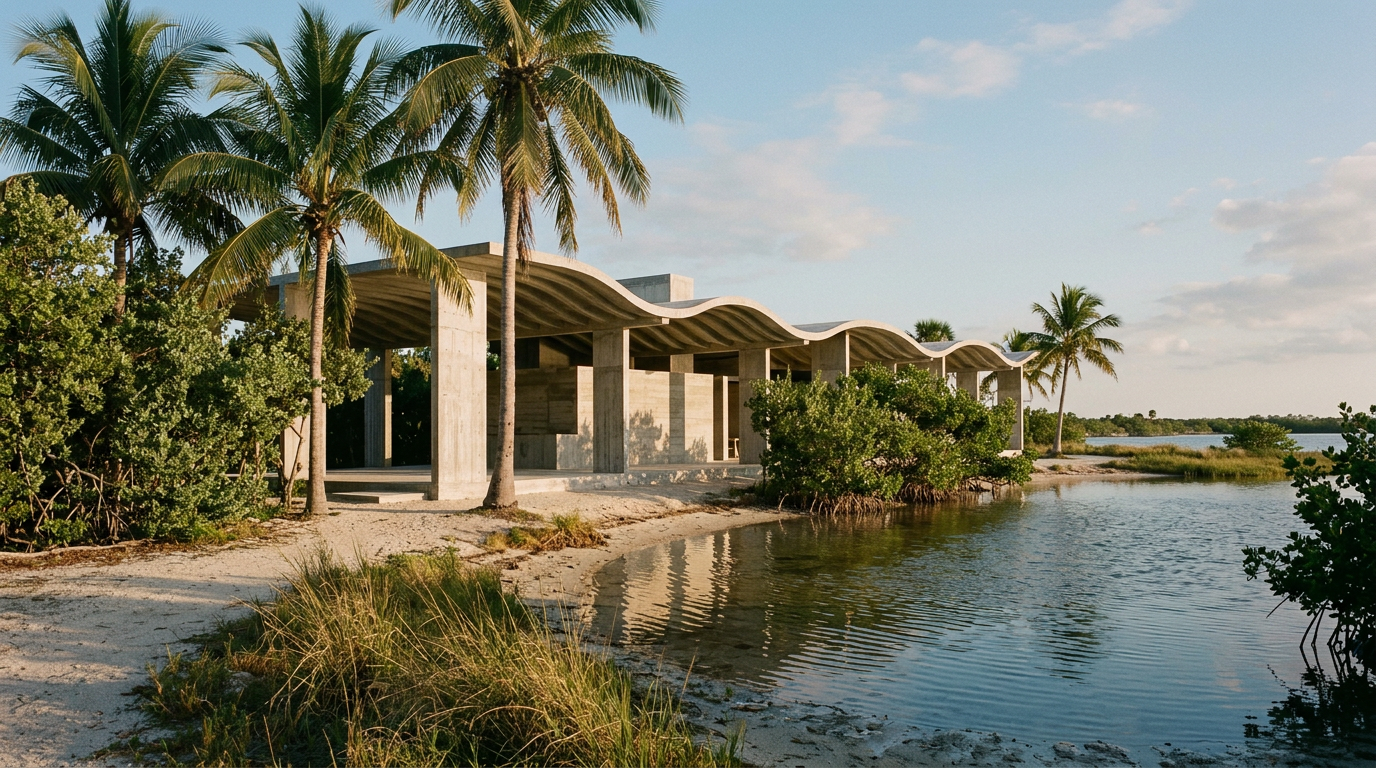
In the rapidly evolving landscape of Hainan, China, the Sanya CR Land Haitang Bay Waterfront Center stands as a testament to shifting priorities in large-scale commercial development. Designed by Vari Architects and slated for completion in 2026, the 2,000-square-meter facility occupies a sensitive site along the banks of the Sanya Haitang River. The project eschews the traditional verticality often associated with luxury coastal developments, opting instead for an organic, horizontal configuration that seeks to harmonize with the surrounding mangroves, coconut groves, and tidal wetlands.
According to reporting from ArchDaily, the architectural language of the center is explicitly derived from the concept of 'fudo'—a philosophical framework popularized by Japanese thinker Tetsurō Watsuji, which posits that human culture and physical geography are inextricably linked. By prioritizing the climate, soil, and sightlines of the Haitang Bay region, the architects have created a structure that functions more as an extension of the natural topography than as an imposition upon it. This approach reflects a broader trend in contemporary Chinese architecture, where the tension between rapid urbanization and ecological preservation is increasingly resolved through site-specific, low-impact design methodologies.
The Philosophy of Climatic Empathy
At the core of the Haitang Bay Waterfront Center is the rejection of the 'object-building' paradigm. In coastal regions, where the harsh realities of tropical weather, high humidity, and salt air are constant factors, architecture often resorts to heavy, hermetically sealed structures that rely on intensive climate control. Vari Architects, however, proposes a porous, village-like typology. The undulating roof structure serves as the primary architectural gesture, providing necessary shade while creating a rhythmic interplay between built form and the lush, vertical growth of the local tropical flora.
This strategy of 'climatic empathy' is not merely aesthetic; it is a structural response to the local environment. By utilizing a continuous, sweeping roofline, the architects create a microclimate beneath the structure, mitigating the intense solar gain typical of the Hainan region. The use of metal as a primary material for the roof, contrasted against the organic density of the surrounding wetlands, creates a deliberate dialogue between the manufactured and the natural. This duality serves to anchor the building within its specific ecological context, suggesting that the future of coastal development lies in the ability of structures to participate in, rather than compete with, the landscape.
Structural Dynamics and Spatial Flow
The mechanism by which the center achieves its organic feel is through the careful management of ground-level connectivity. Traditional waterfront developments often create hard edges, effectively severing the connection between the urban program and the water. The Haitang Bay project, conversely, employs a permeable layout that encourages movement between the interior spaces and the riverbank. This spatial strategy mirrors the natural ebb and flow of the tides, allowing the architecture to breathe in tandem with the landscape it inhabits.
From a technical perspective, the building's scale is intentionally modest compared to the expansive master-planned resorts that characterize much of Sanya’s coastline. By breaking the 2,000-square-meter footprint into a series of interconnected volumes, the architects avoid the visual dominance that typically accompanies large commercial projects. This fragmentation allows for a more nuanced engagement with the site, where the 'village' concept serves as a tool for human-scale interaction. The shadows cast by the undulating roof are not just functional elements for thermal comfort; they serve as spatial organizers, defining exterior gathering spaces that transition seamlessly into the interior environment.
Implications for Coastal Stakeholders
For developers and regulators in Hainan, the Haitang Bay project offers a compelling case study in sustainable luxury. As the region continues to position itself as a premier international tourism destination, the pressure to balance economic growth with environmental stewardship has never been greater. The success of such a project suggests that high-end commercial viability does not necessarily require the sacrifice of ecological integrity. Instead, it demonstrates that developers can leverage architectural sensitivity as a value-add, creating destinations that are more resilient and culturally resonant.
For competitors in the region, the project poses a challenge to the established norms of coastal master planning. If a project of this scale can successfully integrate with the wetlands, it raises the bar for future developments regarding their environmental footprint and long-term maintenance. Regulators may look to this model as a blueprint for future zoning requirements, potentially mandating higher levels of site-specific responsiveness in coastal developments to protect the fragile ecosystems that underpin the region’s attractiveness to both residents and tourists.
The Uncertain Horizon of Organic Development
Despite the architectural promise of the Haitang Bay project, the long-term efficacy of its organic approach remains to be seen. The maintenance of such a structure in a harsh, salt-heavy tropical environment presents significant operational challenges. While the design is intended to harmonize with nature, the reality of living, evolving ecosystems means that the building’s relationship with the landscape will shift over time. Whether the structure can retain its intended character as the surrounding vegetation matures and the coastal environment changes is a question that only time will answer.
Furthermore, the project exists within a broader commercial ecosystem that often prioritizes short-term returns over long-term architectural legacy. The ability of the Haitang Bay Center to serve as a sustainable, functional, and aesthetically enduring space depends heavily on the commitment of its operators to preserve the delicate balance achieved by the designers. As the project reaches completion in 2026, the industry will be watching to see if this 'village' model can scale effectively and whether it provides a viable template for the future of Chinese coastal development.
As the architectural discourse around climate-responsive design continues to evolve, the Haitang Bay project serves as a reminder that the most sophisticated solutions are often those that listen most closely to the land. Whether this approach will become a standard for coastal development or remain an outlier in a market driven by rapid expansion is a matter that will unfold as the project integrates into the daily life of Sanya.
With reporting from ArchDaily
Source · ArchDaily