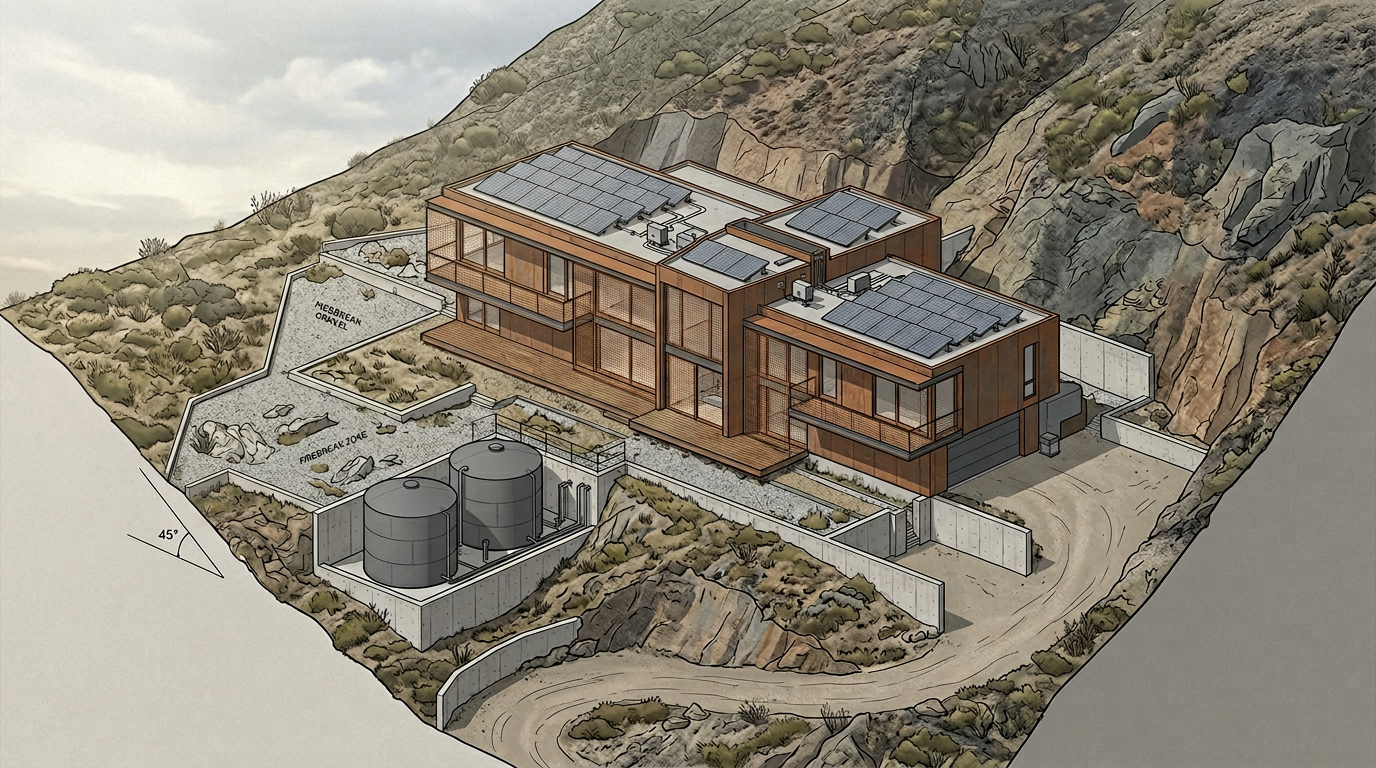
In the hills of Healdsburg, Northern California, the Pine Flat Residence stands as a quiet testament to the shifting priorities of contemporary residential architecture. Designed by Faulkner Architects, the structure replaces a home lost during the 2019 Kincade Fire, utilizing a combination of corrugated Corten steel, ember-resistant screens, and advanced water-retention systems to mitigate the existential threat of wildfire. The project, which occupies a steep slope in the Mayacamas Mountains, serves as a case study for how modern design must now account for extreme environmental stressors that were once considered peripheral to the architect’s mandate.
According to reporting from Dezeen, the residence is not merely a dwelling but a functional tool for survival in a region increasingly defined by fire risk. By reusing the concrete foundation of the previous structure and integrating off-grid utilities such as a solar array and hydroelectric power, the design team has prioritized durability and self-sufficiency. This approach underscores a broader architectural thesis: in the face of climate instability, the traditional luxury home model is being supplanted by a rigorous, engineering-led philosophy that treats the house as a resilient, self-contained organism within a volatile landscape.
The Shift Toward Defensive Architectural Systems
The history of mountain architecture in Northern California has long been defined by a tension between expansive views and the harsh realities of the wildland-urban interface. Historically, residential design in these regions prioritized transparency and integration with the outdoors, often relying on combustible materials like cedar siding or expansive, unshielded glass. However, as the frequency and intensity of wildfires have escalated, the structural requirements for safety have fundamentally altered the design palette. Architects are now forced to reconcile the desire for aesthetic openness with the technical necessity of hardening the building envelope against radiant heat and airborne embers.
Faulkner Architects’ reliance on Corten steel—a material that forms a stable, rust-like appearance and possesses high heat resistance—reflects a departure from the ornamental use of materials toward a functional, protective exterior. This is not merely an aesthetic choice but a defensive one. By creating a shell that is inherently noncombustible, the design shifts the focus from fire prevention to fire survivability. This evolution mirrors a wider structural shift in the construction industry, where building codes and architectural standards are beginning to converge around the necessity of creating "defensible space" not just in the landscaping, but in the very core of the structure itself.
The Mechanism of Passive Survivability
The core mechanism behind the Pine Flat Residence lies in its integration of passive utility, particularly regarding water management. The residence captures 100 percent of its stormwater, channeling it through a cantilevered gutter system into a steel basin that doubles as a backup firefighting water source. This system serves a dual purpose: it manages the site's ecology during the rainy season and provides a tactical resource during a fire event. The inclusion of a Pelton wheel for hydroelectric power, fueled by these same water flows, further illustrates an integrated approach to off-grid resilience, where the house functions as a closed-loop system.
This logic of "passive survivability" extends to the home's mechanical systems and accessibility features, such as the pre-framed elevator core designed for future-proofing. By designing for long-term lifecycle performance rather than immediate visual impact, the architects have created a model that challenges the traditional developer-led approach to mountain housing. The design acts as a buffer between the occupant and the environment, utilizing the slope to embed the building into the landscape while using fire-resistive technology to shield it from the external elements. It is a sophisticated application of engineering where safety features are not hidden behind walls, but are instead integrated into the building’s identity.
Implications for Regulators and Development
The implications of this design shift extend far beyond individual residential projects, potentially influencing insurance markets, local zoning regulations, and the broader real estate development sector. As climate risks become more quantifiable, insurers are increasingly demanding higher standards for fire-resistant construction as a condition for coverage. Projects like the Pine Flat Residence provide a blueprint for how developers might navigate these tightening requirements while maintaining property value. If the industry can standardize these resilience features, it may reduce the systemic risk currently faced by communities in high-risk zones.
However, this focus on high-end, bespoke resilience raises questions about accessibility and the democratization of safety. While architects can design for survival, the cost of implementing such advanced infrastructure—from Corten steel to private water-retention systems—remains significant. Regulators face the challenge of determining how these design principles can be scaled to more affordable housing, or whether the burden of fire-resilience will inevitably lead to a bifurcated real estate market where only the wealthy can afford to build in high-risk, high-beauty landscapes. The tension between the desire to live in nature and the requirement to protect oneself from it is becoming a defining conflict of modern housing policy.
The Outlook for Wildland-Urban Architecture
What remains uncertain is the long-term efficacy of these design interventions as the climate continues to evolve. While current systems like exterior sprinklers and fire-resistive shells are effective against standard wildfire conditions, the increasing intensity of "megafires" may eventually push these designs to their limits. The question is whether architecture can keep pace with environmental degradation, or if there is an upper limit to the level of protection that can be built into a private residence. Architects and engineers must continue to monitor the performance of these materials under increasingly extreme conditions.
Moving forward, the industry will likely see a greater emphasis on data-driven design, where site-specific modeling of wind patterns and fuel loads informs every aspect of a home's geometry. The integration of fire-fighting infrastructure directly into the home’s design is a significant step, but it represents only one facet of a much larger challenge. As designers, regulators, and residents navigate the risks of the wildland-urban interface, the definition of a successful home will continue to be measured less by its appearance and more by its ability to endure.
As the intersection of residential development and environmental hazard continues to evolve, the question of whether our built environment can truly adapt to an era of permanent climate risk remains open. The Pine Flat Residence demonstrates that while the tools for resilience exist, the broader challenge lies in applying these standards at scale and ensuring that the pursuit of safety does not come at the expense of our relationship with the landscape.
With reporting from Dezeen
Source · Dezeen Architecture