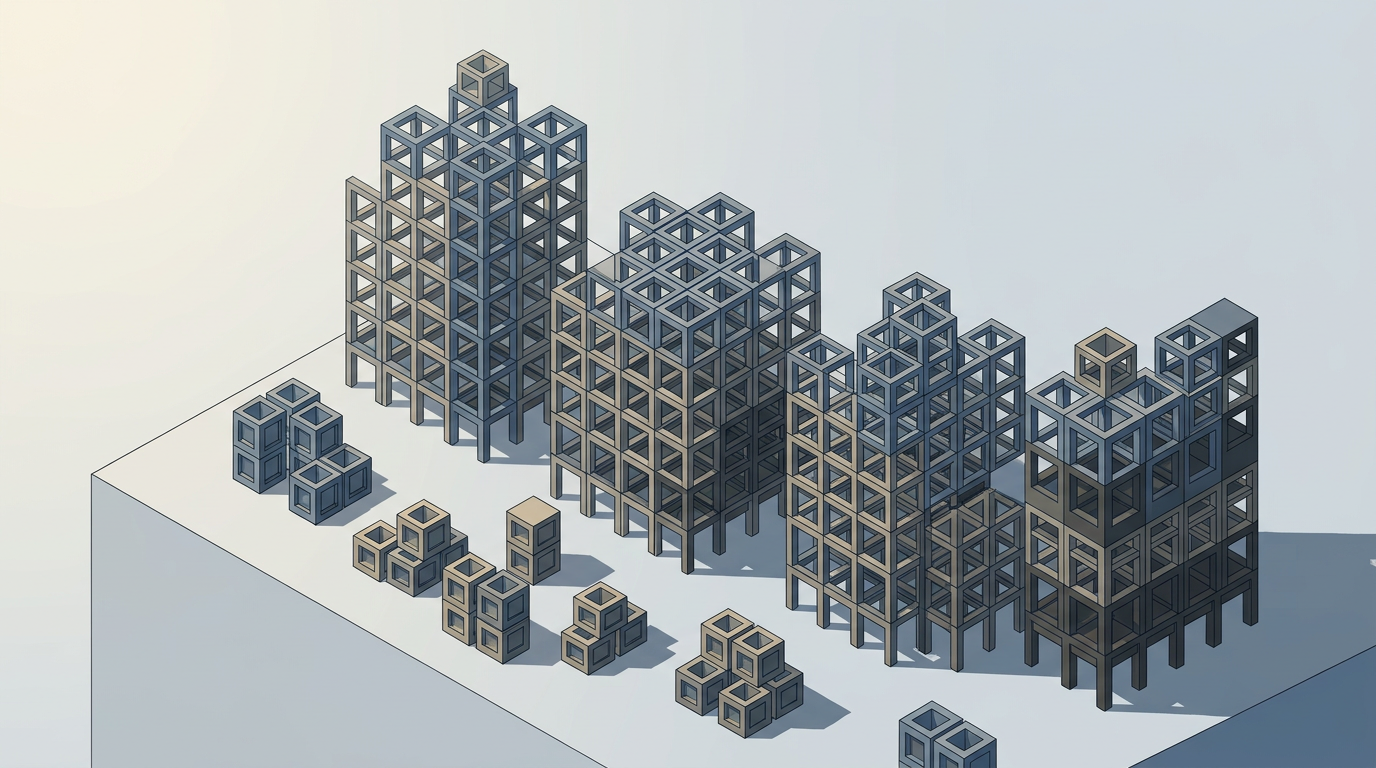
The construction industry has long remained one of the most carbon-intensive sectors of the global economy, characterized by heavy reliance on concrete, steel, and manual labor-intensive processes. A recent feasibility study conducted by researchers at the Massachusetts Institute of Technology (MIT) proposes a radical departure from these conventional methods. By utilizing modular 3D subunits known as "voxels," the team has developed a framework for robotically assembled structures that could challenge the dominance of 3D concrete printing and steel framing.
According to reporting from MIT News, the proposed system leverages "MILAbots"—inchworm-like robots capable of crawling across structures to snap-fit these lattice-based units into place. The study suggests that this method could reduce embodied carbon by as much as 82 percent compared to current industry standards, while simultaneously improving construction speed and offering a modularity that traditional concrete structures simply cannot match. This research marks a pivotal attempt to bridge the gap between high-performance aerospace engineering and the practical, often stagnant, realities of civil architecture.
Aerospace Principles in the Built Environment
The conceptual foundation of this research lies in the cross-pollination of industries. For decades, the Center for Bits and Atoms (CBA) at MIT has refined voxel-based assembly for high-stress environments, including airplane wings and space structures. The core argument presented by the researchers is that if aerospace engineers can achieve extreme strength-to-weight ratios through discrete, lattice-structured components, the same principles should be applicable to buildings. The shift here is from the "monolithic" mindset—where a building is poured or welded as a singular, permanent entity—to a "discrete" mindset.
This transition is not merely aesthetic or structural; it is fundamentally computational. By treating a building as a collection of interlocking, self-aligning parts, the construction process becomes a digital fabrication task. This allows for a level of precision and optimization that traditional on-site construction struggles to replicate. By removing the need for complex, heavy-duty connectors, the voxel system simplifies the assembly logic, allowing for faster deployment and reduced reliance on massive, energy-intensive machinery. The use of an octet lattice design ensures that the structure achieves rigidity through its own geometry, a direct application of aerospace engineering to the domestic sphere.
The Mechanics of Modular Productivity
The efficacy of this approach hinges on the mechanism of parallel, distributed robotic labor. The MILAbots operate by anchoring themselves to the existing structure and extending their bodies to place new voxels, a process that is inherently scalable. While a single robot might appear inefficient when compared to a human crew or a large concrete printer, the system is designed for massive parallelization. By deploying a swarm of 20 or more robots, the construction timeline is compressed significantly, with the researchers projecting an average of 99 hours for a one-story structure, compared to 155 hours for traditional methods.
Beyond speed, the economic and environmental incentives are tied to the choice of materials. The study highlights that the carbon footprint is highly sensitive to the material used; while plastic voxels present challenges, steel and plywood variants demonstrate significant environmental advantages. The system introduces a degree of reversibility that is largely absent in modern construction. Because the structures are assembled through snap-fit connections rather than chemical bonding agents like mortar or permanent welds, the components could theoretically be disassembled, repurposed, or recycled at the end of a building's lifecycle. This circularity represents a significant departure from the "demolish and discard" model that currently defines urban development.
Stakeholder Implications and Industry Tensions
The implications of such a technology extend far beyond the laboratory. For regulators, the adoption of robotic assembly would necessitate a total re-evaluation of building codes, which are currently predicated on traditional materials and manual inspection. If a building is assembled by a swarm of robots, the burden of safety verification shifts from the craftsman to the digital instruction set and the mechanical reliability of the assembler robots. This creates a regulatory tension: how does a municipality certify a structure that is, by design, modular and potentially reconfigurable?
For the construction industry, the entry of robotic assembly poses a threat to the current labor model but offers a solution to the persistent productivity stagnation that has plagued the sector for decades. Competitors in the 3D concrete printing space may find their carbon-heavy processes under scrutiny if this voxel-based approach proves scalable in real-world conditions. Consumers and developers, meanwhile, face a trade-off between the upfront cost of advanced robotic equipment and the long-term gains in sustainability and adaptability. The ability to add a room to a house by simply "printing" more voxels onto the existing lattice could redefine the relationship between property owners and their physical spaces.
Open Questions and the Path to Deployment
Despite the promising results, several technical and practical hurdles remain. The researchers have yet to address the performance of these structures under lateral loads, such as seismic activity or high winds, which are critical considerations for any habitable building. Furthermore, the integration of vital building systems—insulation, electrical wiring, and plumbing—within a lattice-based structure remains an open area of design. The current model is a proof of concept for the structural skeleton, but the transition to a functional, climate-controlled environment requires significant engineering advancements.
Looking ahead, the planned testbed in Bhutan serves as a crucial milestone for assessing the robustness of the MILAbots in diverse, real-world conditions. The transition from a controlled lab environment to a "super fab lab" in a developing region will provide the data necessary to understand the system's true scalability. As the researchers continue to refine the interface between human designers and robotic assemblers, the broader question remains whether the industry can move past the inertia of centuries-old building techniques to embrace a discrete, digital future.
Ultimately, the success of this approach will depend on whether the efficiency gains in construction and the environmental benefits of circularity can overcome the inherent resistance to changing the fundamental way we build. Whether voxel-based assembly becomes a mainstream reality or remains a niche aerospace-inspired novelty will be determined by the next phase of structural testing and the willingness of the construction sector to adopt a fundamentally different paradigm of assembly.
With reporting from MIT News
Source · MIT News


