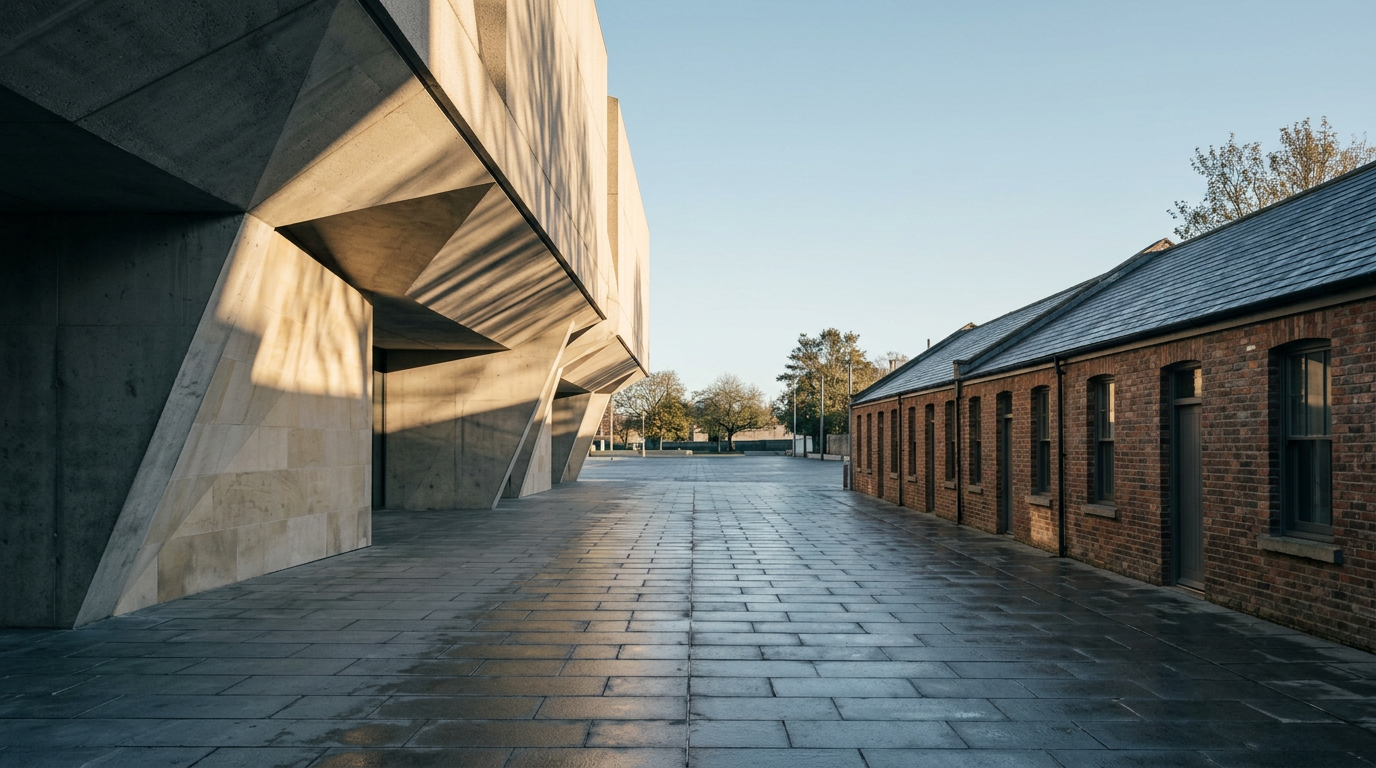
The V&A East Museum in Stratford’s East Bank, designed by the firm O’Donnell + Tuomey, has officially entered the London cultural landscape as a significant addition to the city’s architectural fabric. Positioned within a broader development strategy for the Queen Elizabeth Olympic Park, the museum represents a departure from traditional, monolithic cultural institutions, opting instead for a design language that attempts to mediate between the grandiose scale of the Olympic legacy and the localized character of east London. According to reporting from The Architects’ Journal, the building, which initially appeared to some observers as an exercise in aesthetic eccentricity, reveals a more nuanced internal logic upon closer inspection, characterized by structural elegance and meticulous spatial planning.
This project arrives at a pivotal moment for urban cultural planning in the United Kingdom, where the efficacy of "starchitecture" as a driver for local economic and social growth is under renewed scrutiny. The editorial thesis here is that the V&A East succeeds not merely as a container for artifacts, but as a deliberate attempt to reconcile the often-conflicting pressures of institutional prestige and community integration. By prioritizing connectivity and internal permeability, the design team has sought to mitigate the risks of cultural gentrification that frequently accompany large-scale developments in post-industrial urban zones, setting a potential benchmark for future public-private cultural ventures.
The Architecture of Contextual Mediation
The challenge of designing for the East Bank is fundamentally one of scale. The Olympic Park site is defined by the expansive, high-visibility infrastructure left behind by the 2012 Games, a landscape that can easily overwhelm more intimate human-scale interactions. O’Donnell + Tuomey’s approach to the V&A East reflects a sophisticated understanding of this tension. Rather than competing with the sheer volume of the surrounding structures, the firm has employed a design strategy that emphasizes tactile materiality and layered complexity. This approach serves to break down the perceived mass of the building, creating a series of visual rhythms that feel responsive to the viewer’s movement through the space rather than imposing a static, singular perspective.
Historically, the V&A’s South Kensington campus has been defined by its Victorian-era grandeur and its role as a centralized repository of global design history. The expansion into Stratford marks an institutional pivot toward a more decentralized, accessible model. The architectural response to this mandate involves moving away from the "temple of culture" archetype toward a more porous, transparent model of engagement. By utilizing a design language that is both structurally bold and programmatically intuitive, the architects have attempted to create a bridge between the museum’s historical legacy and the diverse, contemporary demographics of the surrounding boroughs. This is not merely a matter of aesthetic choice but a strategic decision to make the institution feel like an extension of the public realm.
Mechanisms of Urban Integration
The efficacy of a modern cultural institution is increasingly measured by its ability to facilitate social permeability. At the V&A East, the mechanism for this is primarily found in the organization of its circulation spaces and the deliberate placement of public-facing functions. The museum functions as a connective tissue between the park’s primary thoroughfares and the more granular street-level life of Stratford. By integrating public access points that do not require navigation through formal ticketing or security barriers, the design encourages spontaneous interaction, effectively lowering the psychological threshold for entry that often alienates local populations from major national institutions.
Furthermore, the internal planning of the museum reflects a move toward flexibility. In an era where the traditional museum experience is being challenged by digital engagement and changing visitor habits, the spatial design must accommodate evolving modes of curation. The V&A East utilizes a modular approach to its galleries, allowing for a diverse range of exhibition formats that can shift in response to both curatorial requirements and community-led programming. This flexibility is a critical mechanism for long-term institutional survival, ensuring that the building does not become a static monument but remains a living environment capable of reflecting the shifting cultural discourse of the city.
Stakeholder Dynamics and Regulatory Tensions
For regulators and urban planners, the V&A East serves as a critical test case for the efficacy of public-funded cultural investment in large-scale regeneration projects. The success of such ventures is rarely determined by the architecture alone; it is the result of a delicate balance between institutional mission, government funding mandates, and the expectations of local residents who are often wary of displacement or the imposition of external cultural values. The tension here lies in ensuring that the institution remains a global destination while simultaneously functioning as a genuine community asset. If the museum fails to cultivate a deep relationship with the local population, it risks being perceived as an elite enclave, regardless of its architectural merits.
Competitors in the cultural sector are closely watching the V&A East to determine whether this decentralized model is replicable. As budgets for public infrastructure tighten globally, the ability to demonstrate high social return on investment through architectural design is becoming a prerequisite for securing capital. The V&A East highlights a recurring theme in contemporary urbanism: the necessity of moving beyond the iconic building as a branding exercise toward an infrastructure that provides tangible social and economic utility. The stakeholders involved—ranging from the museum’s leadership to local council members and private developers—are now operating in an environment where the social license to operate is as important as the planning permission itself.
The Outlook for Cultural Infrastructure
The long-term impact of the V&A East remains an open question, particularly regarding how the building will age and how its programming will evolve alongside the changing demographics of Stratford. The architectural success of the initial design is a necessary foundation, but the true test of the museum’s relevance will occur over the next decade. Analysts will be monitoring whether the institution can maintain its commitment to accessibility as it faces the inevitable pressures of institutional growth and the potential for shifts in public funding priorities. The intersection of cultural policy and urban development is inherently volatile, and the V&A East is situated squarely at the center of this uncertainty.
Furthermore, the broader question of whether such large-scale investments can truly foster social cohesion remains a subject of intense debate among urban theorists. While the V&A East provides the physical infrastructure for engagement, the social outcomes depend on a complex array of factors, including education, local economic policy, and the museum’s own internal culture. As the project matures, the focus will likely shift from the architectural discourse to the longitudinal data regarding visitor demographics and the museum’s impact on the local creative economy. The evolution of the East Bank as a whole will continue to provide a compelling narrative on the role of culture in the modern city.
As the V&A East establishes its presence within the Stratford landscape, the conversation surrounding its design and purpose will undoubtedly shift from the aesthetic to the functional. Whether the building succeeds as a catalyst for genuine community integration or remains a landmark of institutional expansion will be determined by the ongoing dialogue between the institution and the diverse public it aims to serve. The path forward for such projects remains complex, demanding both architectural vision and sustained institutional commitment to the realities of the local urban fabric.
With reporting from The Architects’ Journal
Source · Architects Journal