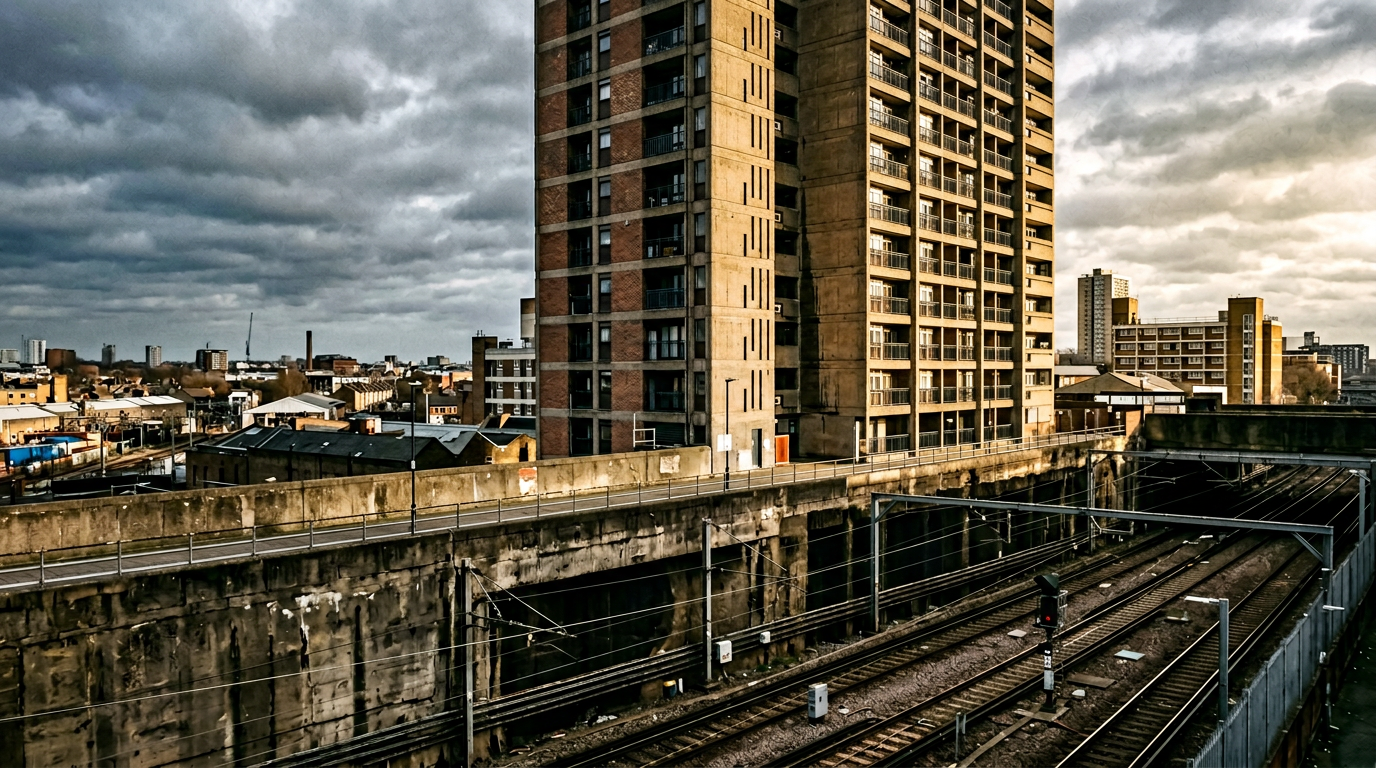
Gordon Shrigley has received planning approval for a residential development situated adjacent to a six-meter-deep railway cutting near Streatham Hill station in South London. The project, characterized by its proponents as a 'monumental' architectural intervention, seeks to maximize utility on a site previously considered challenging due to its proximity to active transport infrastructure. According to Architects’ Journal reporting, the approval marks a significant milestone for the firm, highlighting the continued push to utilize marginal urban land to address persistent housing shortages in the United Kingdom.
This approval arrives at a moment of heightened sensitivity toward urban development, where the definition of 'monumental' is increasingly scrutinized by local stakeholders. While architects often view such projects as feats of engineering and spatial efficiency, the surrounding community often experiences these developments through the lens of disruption and gentrification. This tension forms the core of a broader debate: as cities attempt to densify, the interplay between innovative design and public consent becomes a central challenge for urban planning, particularly in historically established neighborhoods.
The Evolution of Urban Infill Strategy
Urban infill, the practice of developing vacant or underutilized parcels within existing urban areas, has become the primary mechanism for growth in land-constrained cities like London. The Streatham Hill project exemplifies this approach by attempting to reclaim space near transit hubs, which is theoretically sound from a sustainability and transit-oriented development perspective. By placing housing near major transport arteries, developers argue that they are reducing reliance on private vehicles and fostering more walkable, integrated communities. Historically, this strategy has been championed by planners as the most effective way to combat urban sprawl.
However, the structural context has shifted significantly over the past decade. The rise of public skepticism regarding the benefits of such projects has changed the landscape for developers. It is no longer sufficient to demonstrate technical feasibility; architects and developers must now navigate a complex ecosystem of community engagement and political resistance. The term 'monumental,' while intended to describe the aesthetic or structural impact of a building, can often be interpreted by local residents as an imposition of scale that ignores the existing character of their neighborhood. This misalignment between the architectural vision and the lived experience of the community creates a friction that is increasingly difficult to resolve through standard planning processes.
The Mechanism of Public Resistance
To understand the backlash against modern housing developments, one must look at the shifting incentives for all parties involved. For the developer, the incentive is to maximize the return on investment by optimizing the buildable area of a site, regardless of its topographical or logistical challenges. For the regulator, the goal is to balance the urgent need for housing units against the political pressure of local constituencies. When these two motivations collide, the public often feels excluded from the decision-making process, leading to a reflexive opposition that transcends the merits of any individual design.
This resistance is not merely about aesthetics; it is deeply rooted in concerns about who bears the cost of innovation. When a new building is described as 'monumental' in a dense urban environment, the immediate question for residents is whether this project will improve their quality of life or merely serve the interests of capital while placing additional strain on local services. The mechanism of modern planning often fails to bridge this gap, as the technical language of architecture and urbanism rarely translates into the social language of community value. Consequently, even well-intentioned projects are frequently caught in a cycle of litigation and protest, which, in turn, drives up the cost of development and discourages further investment.
Implications for Stakeholders and Regulators
For regulators, the challenge lies in creating a framework that encourages necessary density without alienating the public. If the planning system is perceived as a tool for unchecked development, it risks losing its legitimacy, potentially leading to more restrictive policies that could stifle growth entirely. Conversely, if local opposition is given too much weight, the resulting paralysis could exacerbate the housing crisis, leaving the city incapable of accommodating its growing population. The Streatham Hill project serves as a microcosm of this dilemma, demonstrating the difficulty of balancing high-density ambitions with local environmental realities.
Competitors in the architectural and development sectors are watching these dynamics closely. The ability to successfully navigate the approval process is becoming as important as the design itself. Firms that can demonstrate a genuine commitment to community integration—beyond mere compliance with planning regulations—are likely to gain a competitive advantage in an environment where public trust is a scarce resource. For the consumer, the outcome is equally uncertain; while more housing is objectively needed, the long-term impact on neighborhood character and community stability remains a point of contention that cannot be solved by architecture alone.
The Outlook for Urban Development
What remains uncertain is whether the current planning models can adapt to the rising tide of skepticism. As cities worldwide face similar pressures, the case of Streatham Hill highlights the limits of top-down urbanism. The question is not whether we should build more housing, but how we can build it in a way that is perceived as legitimate by those who live in the shadows of these new structures. The future of urban development will likely depend on the ability of architects to engage more transparently with the public, moving away from a focus on the 'monumental' and toward a focus on the 'relational.'
As we look forward, the tension between the necessity for rapid expansion and the desire for neighborhood preservation will likely intensify. The success of projects like the one in Streatham Hill will not be measured solely by their architectural merit or their ability to navigate the planning bureaucracy, but by their long-term ability to integrate into the social fabric of the city. Whether this leads to a more collaborative approach to urban design or a hardening of positions remains an open question for the industry and the public alike.
The evolution of urban planning in the coming years will be defined by how successfully designers and developers can address these deep-seated anxieties. As the project in Streatham Hill proceeds, the focus will inevitably shift from the initial planning approval to the practical reality of its impact on the community, inviting a broader reflection on the future of our urban environments.
With reporting from Architects Journal
Source · Architects Journal