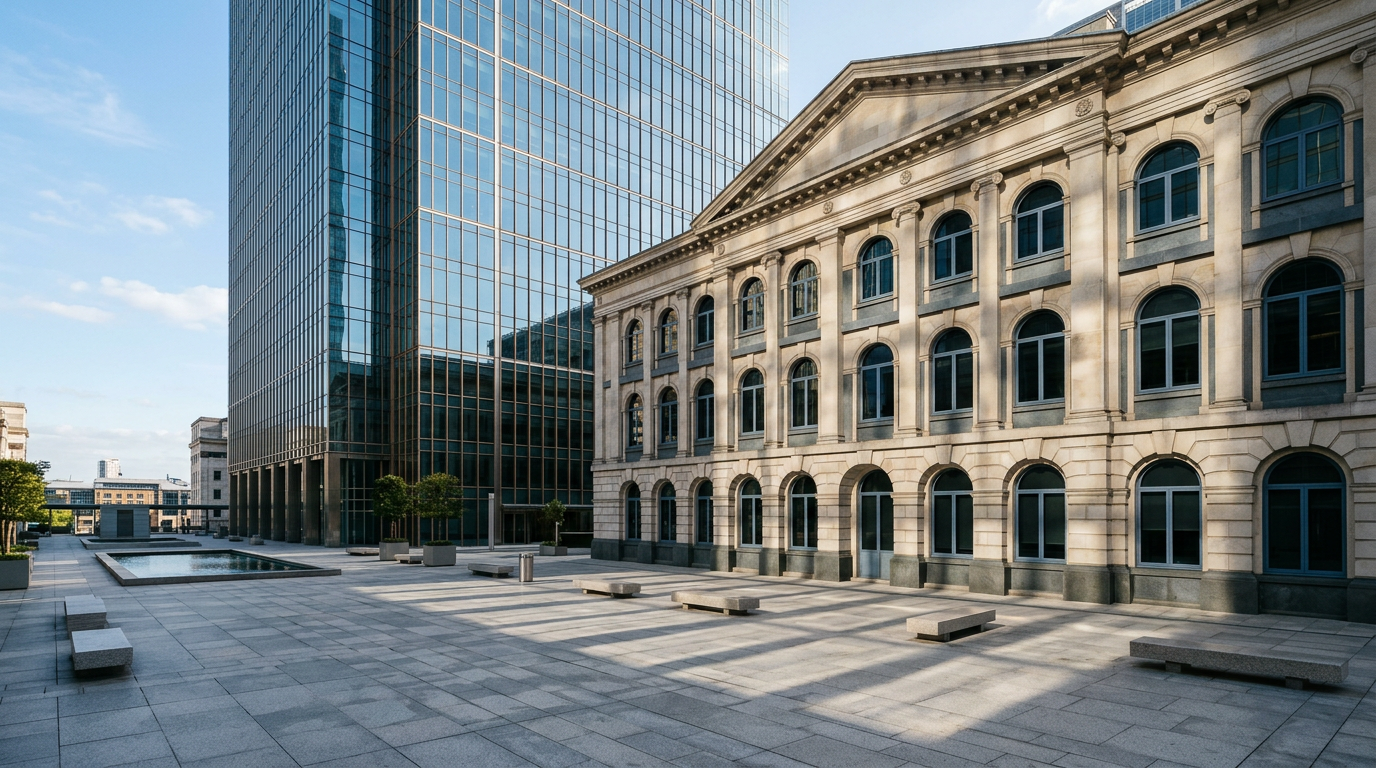
The Twentieth Century Society (C20) has formally requested that Historic England grant protected status to a prominent 1990s Postmodern building located within the Canary Wharf estate. This initiative marks a significant development in the ongoing effort to recognize the architectural value of the late twentieth century, a period often neglected by traditional preservation standards. According to reporting from The Architects’ Journal, the society views this particular structure as the finest remaining example of Postmodern Neoclassical design in London’s primary financial hub.
The application forces a confrontation between the rapid cycles of urban redevelopment and the emerging desire to curate the recent past. By seeking to list a building that sits at the heart of one of the world’s most commercially driven districts, the C20 Society is challenging the assumption that historic preservation should be reserved for structures of a more distant vintage. The case serves as a litmus test for how regulators evaluate the cultural worth of architecture that was born out of neoliberal economic expansion and stylistic experimentation.
The Evolution of Architectural Heritage Criteria
Historically, the process of listing buildings has favored structures that exhibit either exceptional craftsmanship from a bygone era or significant social utility over long stretches of time. However, the definition of what constitutes 'heritage' is inherently fluid, shifting alongside the aesthetic sensibilities of each generation. Postmodernism, characterized by its playful irony, historical references, and rejection of the austere functionalism of the mid-century, has long been a polarizing movement. In the context of Canary Wharf, the aesthetic was not merely a design choice but a symbolic assertion of London’s global financial ambitions during the 1980s and 1990s.
The challenge in preserving such structures lies in the fact that they are often inextricably linked to the commercial interests that commissioned them. Unlike a Victorian civic hall or a medieval cathedral, these buildings were designed to facilitate high-frequency capital flow and project corporate power. Critics of the listing movement argue that protecting such sites might stifle the necessary evolution of the district, which requires constant adaptation to meet the evolving technical and spatial demands of modern financial services. Yet, proponents argue that these buildings represent a distinct chapter in British urban history that is currently at risk of being erased by more generic, glass-heavy developments.
Mechanisms of Institutional Recognition
For a building to receive statutory protection in England, it must meet specific criteria regarding architectural interest and historic significance. The process is rigorous, often requiring evidence that the structure represents a turning point in design or an exemplary vision of its time. The C20 Society’s advocacy relies on the premise that the 1990s Postmodernism found in Canary Wharf is not just a stylistic curiosity, but a sophisticated response to the constraints of the site and the broader cultural zeitgeist of the era. By framing these buildings as significant cultural artifacts, the society aims to move them from the category of 'disposable commercial real estate' to 'protected national heritage.'
This mechanism of recognition is essential because it fundamentally changes the economic calculus for property owners. Once a building is listed, the costs associated with maintenance, retrofitting, and potential demolition increase significantly. It forces developers to engage with the existing fabric of the city rather than treating the urban landscape as a blank slate. This creates a friction point between the preservationist desire to maintain a coherent historical narrative and the market-driven desire for maximum efficiency and modern aesthetic alignment. The outcome of this specific application will likely set a precedent for how other late-twentieth-century commercial buildings are treated in the coming decade.
Stakeholder Tensions in Urban Development
For regulators like Historic England, the decision involves balancing public sentiment and architectural scholarship against the economic realities of a high-value district. If the application is successful, it could signal a broader shift in how the state views the commercial architecture of the late twentieth century, potentially leading to a wave of similar requests for other sites across the UK. Conversely, a rejection would solidify the notion that commercial utility and the aesthetic trends of the 1990s are inherently transitory and not worthy of long-term state-sponsored protection.
For the developers and institutional landlords operating within Canary Wharf, the prospect of listing is a significant operational risk. These entities prioritize flexibility and the ability to modernize floor plates to attract global tenants. The imposition of heritage status acts as a constraint on their ability to optimize assets, potentially leading to long-term disputes over the degree of permitted intervention. Meanwhile, for the public, the debate highlights a growing awareness of the 'vanishing recent past,' where the rapid pace of development threatens to remove the landmarks that define the contemporary identity of the city.
The Outlook for Modernist Preservation
What remains uncertain is whether the architectural community and the wider public have reached a consensus on the value of Postmodernism. While the movement has seen a resurgence of interest in academic circles, its practical application in a dense, commercially sensitive environment like Canary Wharf remains highly controversial. The question of whether we should preserve the symbols of financial deregulation alongside the symbols of civic life is one that will continue to divide architectural critics and urban planners.
Looking ahead, the focus will likely shift to how these buildings can be repurposed for a 'greener' future. The environmental cost of demolition—often referred to as 'embodied carbon'—is becoming a central argument in the preservationist toolkit. If the building cannot be justified on aesthetic grounds alone, it may find protection through the lens of sustainability, as the adaptive reuse of existing structures becomes a more viable strategy than new construction. As these competing pressures of heritage, economics, and sustainability converge, the debate over Canary Wharf’s architectural legacy will continue to evolve.
As the dialogue between the C20 Society and regulatory bodies continues, the fundamental question remains: how much of our recent, commercially driven past should we institutionalize for the future? The outcome of this specific case will provide a clearer understanding of how the UK intends to handle the architectural heritage of the late twentieth century, leaving open the possibility for a more nuanced approach to urban conservation.
With reporting from Architects Journal
Source · Architects Journal