In the heart of Madrid, the Torres Colón skyscrapers stand as a distinct silhouette against the city skyline, a testament to a period of bold experimentation in mid-century urban development. While many buildings are defined by their aesthetic impact, the Torres Colón are defined by their defiance of conventional construction logic. According to reporting from Xataka, the project was conceived by architect Antonio Lamela in the late 1960s, utilizing a technique known as suspended architecture. This method allowed the towers to be built from the top down, a necessity born from the limitations of an irregular, compact plot of land that could not accommodate traditional structural footprints.
The construction of these towers serves as a case study in the intersection of municipal regulation and engineering necessity. Faced with strict zoning mandates for parking and a desire to avoid the visual imposition of a single, massive block, Lamela opted for a twin-tower design that effectively "hung" the floors from a central concrete core. This approach, while technically complex, provided a solution to the spatial constraints of the site, establishing a legacy of structural ingenuity that continues to influence discussions regarding the adaptation of modern corporate environments to dense urban centers.
The Structural Logic of Inversion
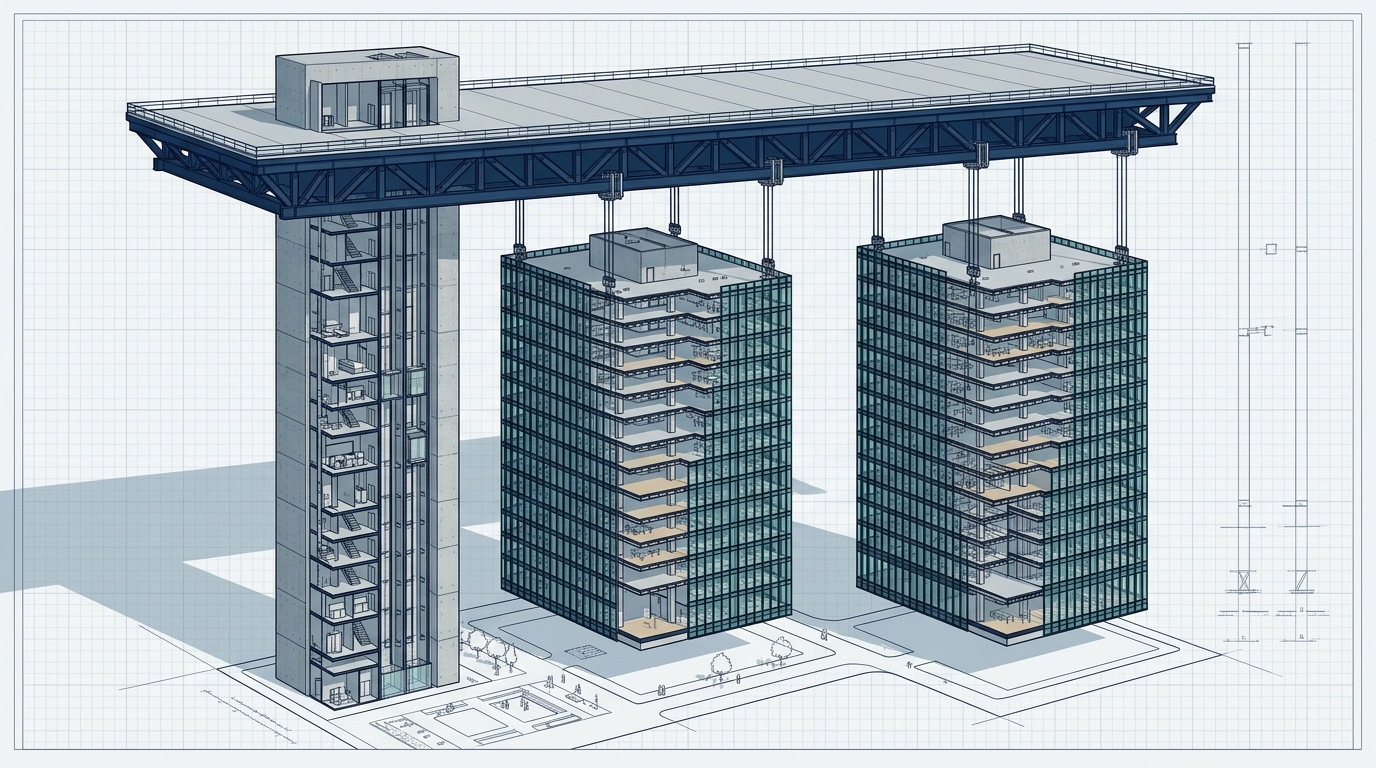
The decision to build the Torres Colón from the top down was not a stylistic choice, but a response to the physical constraints of a 1,710-square-meter plot. In traditional construction, the base supports the weight of all subsequent levels. However, in the case of these towers, the architects identified that the site's irregular geometry and the municipal requirement for extensive parking infrastructure made standard foundation layouts impractical. By creating a narrow, central concrete core and a platform at the summit — often described as a "hanging head" — the structural load was effectively redistributed.
The engineering mechanism relied on the use of high-strength post-tensioned concrete. Rather than resting on columns rising from the ground, the floors were suspended from the upper platform via vertical steel hangers, transferring their weight upward to the core rather than downward to a conventional foundation. This inversion of the standard load-bearing hierarchy transformed the building into a series of three semi-independent structures: the twin towers and the base that serves as their anchor. As Lamela famously remarked, it was as if the building had been turned upside down, a process that required a level of precision in material science that was relatively uncommon for the era.
Navigating Regulatory and Political Friction
The development of the Torres Colón was far from a straightforward execution. Initiated in 1967, the project faced significant delays, including a total work stoppage in 1970 due to what Lamela characterized as political interference from the Madrid municipal government. The uncertainty surrounding the project's future necessitated multiple pivots in its design philosophy. Originally intended as a luxury residential complex, the project was eventually repurposed for office space following a legal settlement with the city, a transition that fundamentally altered the building's functional profile and internal layout.
This shift highlights a recurring theme in urban development: the vulnerability of ambitious architectural projects to the shifting winds of bureaucratic and political priorities. The transition from residential to commercial use, finalized in 1976, required the structure to accommodate an entirely different set of utility and spatial requirements. The fact that the building remained viable through these changes is a testament to the flexibility inherent in its core-and-suspension design. The distinctive crowned appearance at the top — which locals dubbed "the plug" — became a landmark not just for its bold Modernist form, but for its resilience in the face of administrative upheaval.
The Legacy for Modern Corporate Architecture
The implications of the Torres Colón approach extend beyond its historical novelty. In contemporary urban planning, where real estate is increasingly scarce and the demand for efficient, high-density development is unrelenting, the lessons of suspended architecture remain relevant. Developers and architects today are constantly seeking ways to maximize usable space on constrained sites, often looking back at mid-century precedents to understand how to bypass traditional structural limitations. The Torres Colón demonstrates that engineering constraints can, if addressed with sufficient rigor, become the defining feature of an iconic structure.
For regulators and city planners, the towers serve as a reminder of the unintended consequences of rigid zoning laws. While the municipal requirements for parking and verticality were intended to manage urban growth, they inadvertently forced a radical structural solution that defined the city's skyline for decades. This dynamic — where the architect must innovate to satisfy conflicting municipal mandates — remains a central tension in the development of modern metropolitan hubs, where the cost of land often necessitates creative, if unconventional, solutions.
Unresolved Questions of Adaptive Reuse
As Madrid continues to modernize its aging office stock, the question of how to adapt buildings like the Torres Colón for the next century remains open. The very structural characteristics that made them unique in the 1970s — the dependence on a specific central core and the tension-based floor system — present unique challenges for modern retrofitting. As the nature of work shifts toward more flexible, collaborative environments, the rigid, hanging structure of these towers may eventually require significant intervention to remain competitive with newer, more agile office developments.
Whether these structures will be preserved as architectural monuments or undergo extensive gut-renovations to suit changing tenant needs is a matter of ongoing debate in the local real estate sector. The history of the Torres Colón suggests that the building is capable of evolution, but the physical constraints of its inverted design will always dictate the boundaries of that transformation. As the city balances heritage preservation with the demands of a globalized economy, the future of these towers will likely remain a focal point for discussions on the longevity of mid-century corporate architecture.
The evolution of the Torres Colón from a residential concept to an office landmark, and eventually to an enduring symbol of Madrid's structural ambition, underscores the fluidity of urban space. As the city continues to grapple with the challenges of density and the necessity for innovative structural design, the legacy of this inverted skyscraper serves as a reminder that the most durable solutions are often those that turn constraints into opportunities.
With reporting from Xataka
Source · Xataka